
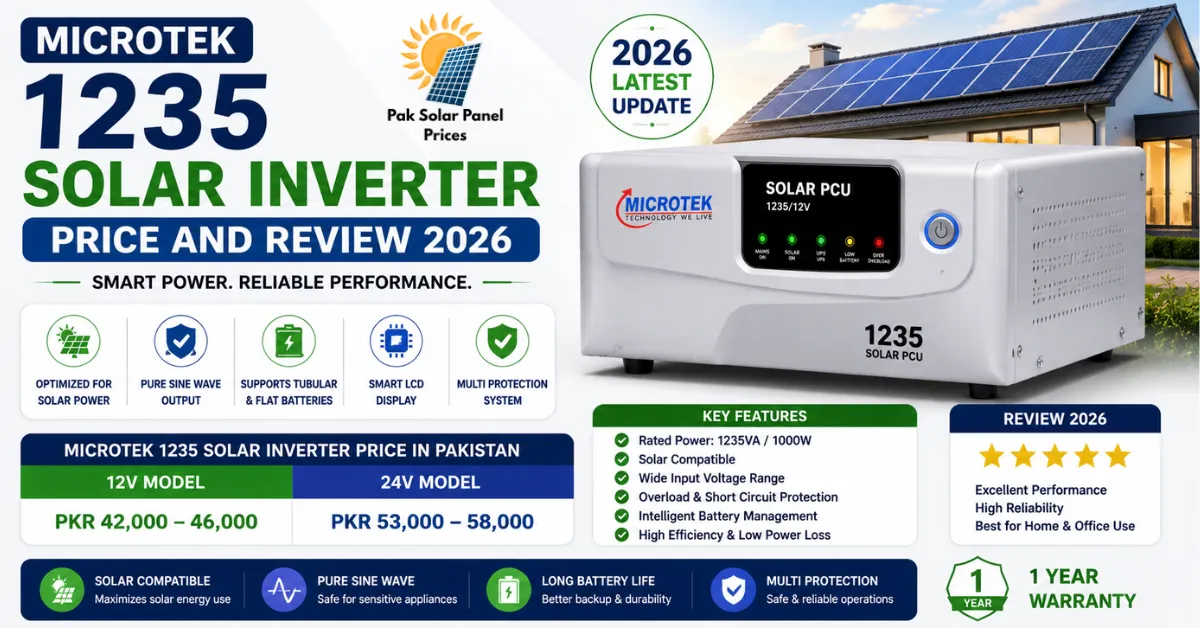
Microtek 1235 Solar Inverter Price in 2026 – Specifications & Latest Price
If you’ve shopped for a small home solar inverter in India, you’ve almost certainly run into the Microtek Solar PCU 1235/12V (also listed as MSUN 1235 or M-SUN-1235/12V). It’s one of the most widely stocked entry-level solar units in the country, sitting at the budget end of Microtek’s catalog a brand that’s been a household name in Indian inverters and UPS systems for decades, long before “solar hybrid” became a marketing buzzword. This review looks at what the 1235 actually is, who it’s built for, and where it falls short compared to newer hybrid alternatives.
What Exactly Is the 1235?
First, an important distinction the marketing often blurs: the 1235 is a Solar PCU (Power Conditioning Unit), not a hybrid solar inverter in the modern sense. That difference matters more than it sounds.
A hybrid inverter (like MuscleGrid’s True Hybrid line or newer Luminous models) is grid-interactive by design it can export surplus power, prioritize solar automatically across complex load profiles, and often supports lithium batteries with app monitoring. A solar PCU like the 1235, by contrast, is a simpler and older architecture: it prioritizes solar to charge the battery and run your load, falls back to mains charging when solar isn’t available, and switches to battery power during an outage all without needing an active grid connection at all. In practice, it behaves like a solar-assisted version of the traditional Indian home inverter/UPS most households already understand, rather than a full smart-grid device.
That’s not a knock it’s actually the point. The 1235 is built for exactly the use case most Indian households have: a small home wanting to cut its grid electricity bill and get backup during load-shedding, without the complexity or cost of a full hybrid system.
Read More: Solar Panel for 1.5 Ton AC in Pakistan 2026 – Panels Required, System Size & Cost
Full Specifications of Microtek 1235 Solar Inverter
| Spec | Detail |
|---|---|
| Capacity | 935VA / 12V |
| Rated AC output | 680 Watts |
| Max solar panel support | 600 Wp |
| Solar charge controller | 35A PWM-based |
| Mains charging | Dual mode, 10A/14A |
| Battery compatibility | Single 12V battery, up to 53A full-load charging current |
| Output voltage | 230V (no load), 180V (full load) |
| Output waveform | Pure sine wave |
| Control system | DSPIC-based microcontroller |
| Display | LCD + graphical status/fault indicators |
| Protection | Overload and short-circuit protection with auto-reset |
| Dimensions / Weight | 38.4 × 37.5 × 19.4 cm / 10 kg |
| Warranty | 2 years |
| Price range | ₹8,300 – ₹17,800 depending on retailer and bundled accessories |
Key Features Microtek 1235 Solar Inverter
Read More: Best RV Solar Panel Kit with Battery and Inverter for Off-Grid Camping
Where It Falls Short Microtek 1235 Solar Inverter
Who This Inverter Is Actually For
The 1235 makes the most sense for a small household or shop running lights, fans, a TV, a small fridge, and similar basic loads broadly under 600–700W combined where the primary goal is trimming the electricity bill and having backup during outages, not building toward energy independence. It’s also a sensible starter unit for someone who wants to “solarize” an existing home inverter setup incrementally, since it works fine without a panel connected on day one.
It’s a weaker fit if you’re running an AC, a submersible pump, or multiple heavy appliances simultaneously the 680W rated output simply isn’t built for that load class, and you’d want to look at Microtek’s own Smart Hybrid 1275 or a higher-capacity hybrid unit from MuscleGrid, Luminous, or Livguard instead.
How It Compares
| Microtek Solar PCU 1235 | MuscleGrid 4.2kW True Hybrid | |
|---|---|---|
| Architecture | Solar PCU (PWM) | True hybrid (MPPT) |
| Rated output | 680W | 4,200W |
| Battery type | Lead-acid/tubular | Lithium (LiFePO4) compatible |
| App monitoring | No | Yes |
| Best for | Small home, basic loads | Full home, AC/pump loads |
| Approx. price | ₹8,300–₹17,800 | ₹39,000–₹45,000 |
This isn’t really an apples-to-apples comparison the two units serve different budgets and household sizes entirely but it illustrates the category gap clearly: the 1235 is an entry point, not a competitor to full hybrid systems.
Read More: Today Solar Panel Price in Pakistan All Brands, System Sizes & City-Wise Rates 2026
Installation and Setup
Setting up the 1235 is straightforward enough for most electricians familiar with standard home inverters, and many buyers install it without hiring a specialized solar technician:
Most installations take under an hour for a single-battery, single-panel setup. If you’re adding this to an existing home inverter system rather than starting fresh, confirm your existing battery’s age and health first pairing a new PCU with a tired, multi-year-old battery is one of the most common reasons buyers report disappointing backup times.
Battery Pairing: What to Budget For
The 1235 itself doesn’t include a battery, so factor that into your total cost. A tubular battery in the 150Ah–200Ah range (commonly paired with this unit) typically adds ₹12,000–₹18,000 depending on the brand and capacity, meaning your realistic all-in cost PCU plus a decent battery plus a basic panel lands closer to ₹30,000–₹40,000 rather than the ₹8,000–₹17,000 sticker price of the PCU alone. This is worth knowing upfront, since PCU-only pricing can make the unit look deceptively cheaper than a comparable hybrid bundle that includes the battery.
Conclusion
The Microtek Solar PCU 1235/12V isn’t trying to be a cutting-edge hybrid inverter, and reviewing it as one misses the point. It’s a well-established, reliably built entry-level solar backup unit for small households that want to shave down their electricity bill and ride out power cuts without a large upfront investment. The PWM controller and lack of app monitoring are real limitations if you’re thinking long-term about scaling your solar setup, but for a first step into solar or a straightforward inverter replacement with solar-readiness built in the 1235 remains a sensible, budget-friendly choice backed by a brand with one of the widest service networks in the country. If you already know you’ll want to run an AC or heavy pump load, or plan to expand your solar array significantly down the line, skip straight to a hybrid MPPT unit instead you’ll outgrow the 1235 faster than its 2-year warranty period.