

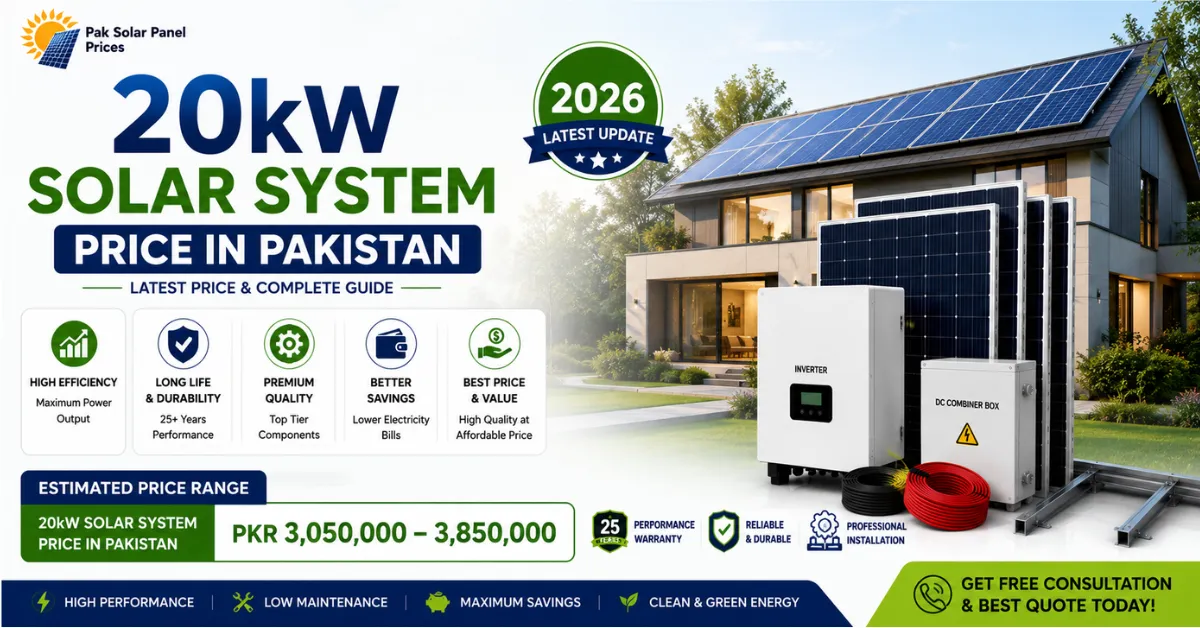
20kW Solar System Price in Pakistan 2026 – Latest Price Guide
At 20kW, solar installations in Pakistan firmly cross into small commercial and large-residential territory. This is the size for 2-kanal homes running 5–7 ACs, joint family residences, large farmhouses, clinics, schools, retail spaces, and light manufacturing units with a three-phase meter regularly recording 2,000+ units a month.
20kW Solar System Price Overview
|
System Type |
Price Range (PKR) |
|---|---|
|
On-grid |
1,800,000 – 2,200,000 |
|
Hybrid, no battery |
2,000,000 – 2,600,000 |
|
Hybrid + battery backup |
3,400,000 – 5,200,000 |
The jump between on-grid and hybrid-with-battery is much larger here than at smaller system sizes battery storage at 20kW scale typically adds PKR 1.6–3 million on its own, which is why most commercial buyers weigh this decision very carefully before committing.
Who This System Is Actually For
|
User Type |
Typical Profile |
|---|---|
|
Large residential |
2-kanal homes, joint family houses, 5–7 ACs running daily |
|
Farmhouses |
Heavy motor loads, tube wells, large property lighting |
|
Clinics / medical facilities |
Daytime-heavy load, backup often justified by equipment sensitivity |
|
Schools / offices |
Full-day operating hours matching solar generation |
|
Retail / light manufacturing |
HVAC, refrigeration, computing equipment, consistent daytime draw |
If your three-phase connection consistently shows less than 1,500 units a month, a 15kW system is likely the more cost-efficient choice; above roughly 2,500 units, it’s worth pricing out 25kW instead.
Read More: 25kW Solar System Price in Pakistan – Installation & Cost Guide
Components and Roof Space
A 20kW system typically uses around 34–36 panels rated at 550–585W each, requiring roughly 1,300–1,600 square feet of unshaded roof south-facing orientation is ideal, since east-west splits can reduce generation by 8–12%. A complete package includes:
Inverter Cost Reference
|
Inverter Class |
Approx. Price (PKR) |
|---|---|
|
Budget/mid-range hybrid (20kW class) |
400,000 – 700,000 |
|
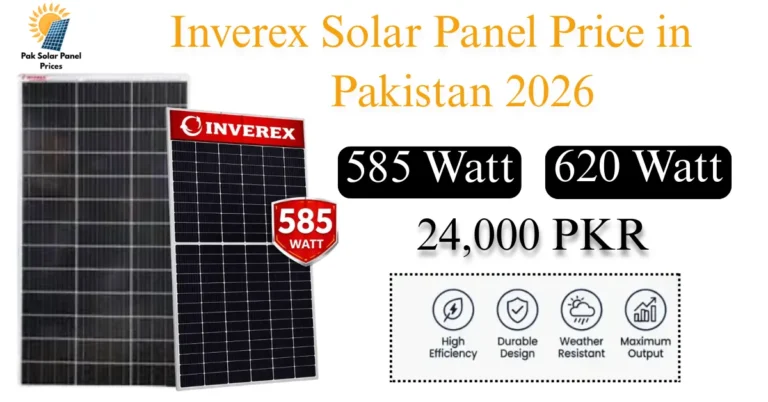
Premium hybrid (Inverex, Growatt high-capacity) |
800,000 – 1,200,000+ |
Inverter choice alone can shift total system cost by several hundred thousand rupees at this scale, so it’s worth deciding early whether you need premium monitoring and warranty support (common for commercial sites with critical uptime needs) or a solid mid-range option is sufficient.
Expected Output and Savings
A 20kW system generates roughly 2,200–2,600 units a month under good sunlight conditions. At Pakistan’s blended tariff rates, this typically translates to:
Is Battery Backup Worth It at This Scale?
For most commercial users, on-grid with net metering is the more sensible default battery storage at 20kW adds a genuinely large cost, and it only pays for itself if outages cause meaningful revenue loss. Where it clearly does make sense:
For a standard office, shop, or large home without these pressures, on-grid usually offers better return on the same rupee.
Payback Period 20kW Solar System
Most 20kW systems pay back within 3–4 years for residential-style use, while commercial installations often pay back faster due to higher tariff slabs and steadier daytime consumption that lines up with generation hours. Exact payback always depends on your specific DISCO, consumption pattern, and whether battery storage is added.
Read More: 30kW Solar System Price in Pakistan 2026 – Latest Cost & Packages
Net Billing Note (2026)
As with other system sizes, Pakistan’s 2026 shift from unit-for-unit net metering to net billing applies here too exported surplus is now bought back at a separate rate rather than swapped one-for-one against grid consumption. At 20kW, where daytime surplus can be substantial, this makes self-consumption planning (timing heavy loads to daylight hours) more financially relevant than before. Existing agreements from before the shift retain their original terms.
Latest Post
- itel Lithium Battery 24V Price in Pakistan 2026 – Latest Price, Specifications & Buying Guide
- Install Solar Panels Cost in Pakistan 2026 – Complete Guide
- Solar Geyser Price in Pakistan
- Millat Battery Price in Pakistan 2026
- Solar Geyser Price in Pakistan 2026 – Latest Rates, Types & Buying Guide
Conclusion
A 20kW Solar System sits comfortably in SME commercial territory while still serving Pakistan’s largest residential properties well. Budget PKR 2,000,000–2,600,000 for a solid hybrid system without a large battery bank, and think carefully about whether your specific use case justifies the substantial extra cost of full battery backup for most users at this size, on-grid with net billing remains the more financially efficient choice.


 Join Channel