

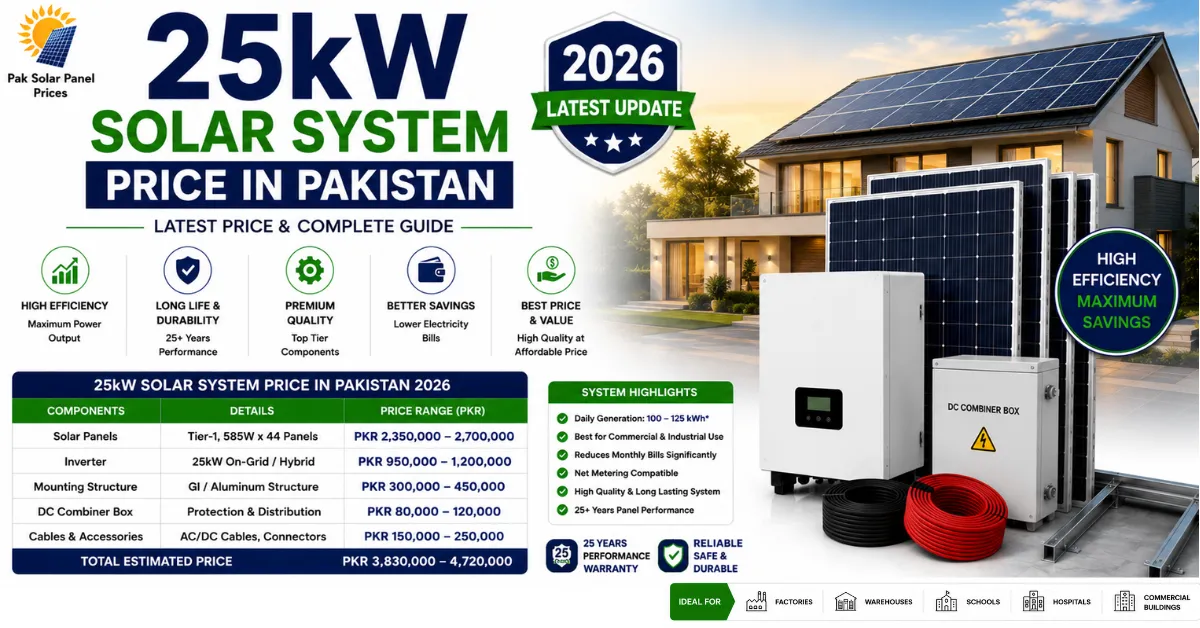
25kW Solar System Price in Pakistan 2026 – Complete Commercial Solar Planning Guide
A 25kW solar system is suitable for people who need much electricity, which is why it is among the topmost installations used for commercial establishments, factories, schools, hospitals, warehouses, hotels, and even large farmhouses. As compared to domestic solar systems, the 25kW installation is built in a way that it provides continuous electricity supply, enabling companies to save on their electricity cost and become more efficient in terms of energy usage.
In case of any company with expensive electricity bills every month, it will be able to produce sufficient amount of electricity through this system to cover at least some of their needs and, in case of being eligible, sell their surplus electricity through net metering.
25kW Solar System Overview
| Feature | Details |
|---|---|
| Recommended Monthly Consumption | 2,500–3,500 Units |
| Daily Solar Production | 95–120 Units |
| Monthly Energy Generation | 2,900–3,600 Units |
| Solar Panels Required | 40–43 Panels (590W–620W) |
| Roof Area Required | 1,700–2,100 sq. ft. |
| Inverter Type | 25kW Three-Phase On-Grid / Hybrid |
| Expected System Life | 25–30 Years |
Latest 25kW Solar System Price in Pakistan (2026)
| Package | Estimated Price (PKR) |
|---|---|
| 25kW On-Grid Solar System | Rs. 1,850,000 – 2,200,000 |
| 25kW Hybrid Solar System | Rs. 2,250,000 – 2,700,000 |
| 25kW Hybrid + 20kWh Lithium Battery | Rs. 2,900,000 – 3,500,000 |
| 25kW Hybrid + 30kWh Lithium Battery | Rs. 3,400,000 – 4,200,000 |
| 25kW Off-Grid Solar System | Rs. 3,200,000 – 4,500,000 |
Where Is a 25kW Solar System Commonly Installed?
This capacity is suitable for locations with continuous daytime electricity demand.
Typical applications include:
- Commercial Offices
- Textile Units
- Schools & Colleges
- Hospitals & Clinics
- Hotels & Restaurants
- Cold Storage Facilities
- Marriage Halls
- Petrol Pumps
- Warehouses
- Large Farmhouses
- Small Manufacturing Industries
Daily Power Generation
One of the biggest advantages of a 25kW solar system is its high electricity output.
| Season | Expected Units |
|---|---|
| Summer | 105–120 Units/Day |
| Winter | 85–100 Units/Day |
| Average Annual Production | 95–120 Units/Day |
How Is the Project Budget Distributed?
Instead of focusing only on the total quotation, understand how your investment is allocated.
| Component | Approximate Cost Share |
|---|---|
| Tier-1 Solar Panels | 45% |
| 25kW Three-Phase Inverter | 18% |
| Mounting Structure | 8% |
| Lithium Battery (Optional) | 15–25% |
| Electrical Protection | 5% |
| Installation & Testing | 7% |
| Engineering & Documentation | Remaining Cost |
On-Grid vs Hybrid – Which Option Makes More Sense?
On-Grid
Recommended when:
- Grid electricity is reliable.
- Your priority is lowering electricity bills.
- You want to maximize net-metering benefits.
- Battery backup is not essential.
Hybrid
Recommended when:
- Load shedding affects business operations.
- Backup power is critical.
- You want energy storage for night-time usage.
- Future battery expansion is planned.
Important Checks Before Installation
Before approving any commercial solar project, verify:
- Genuine Tier-1 solar panels
- Original three-phase inverter
- Proper structural design
- DC & AC surge protection
- Earthing resistance testing
- Performance guarantee
- Official warranty documents
- Remote monitoring system
- Professional commissioning report
Conclusion
The 25kW Solar System is an ideal option for commercial and industrial consumers who are aiming to reduce their cost of operations while also becoming less dependent on energy supply. Even though the cost of acquisition may be high, it can generate sufficient electricity on a daily basis, is eligible for net metering, and has a long operational life span, which makes it economically favorable. The selection of Tier-1 solar panels, a good inverter, and professional installers is vital.

 Join Channel