

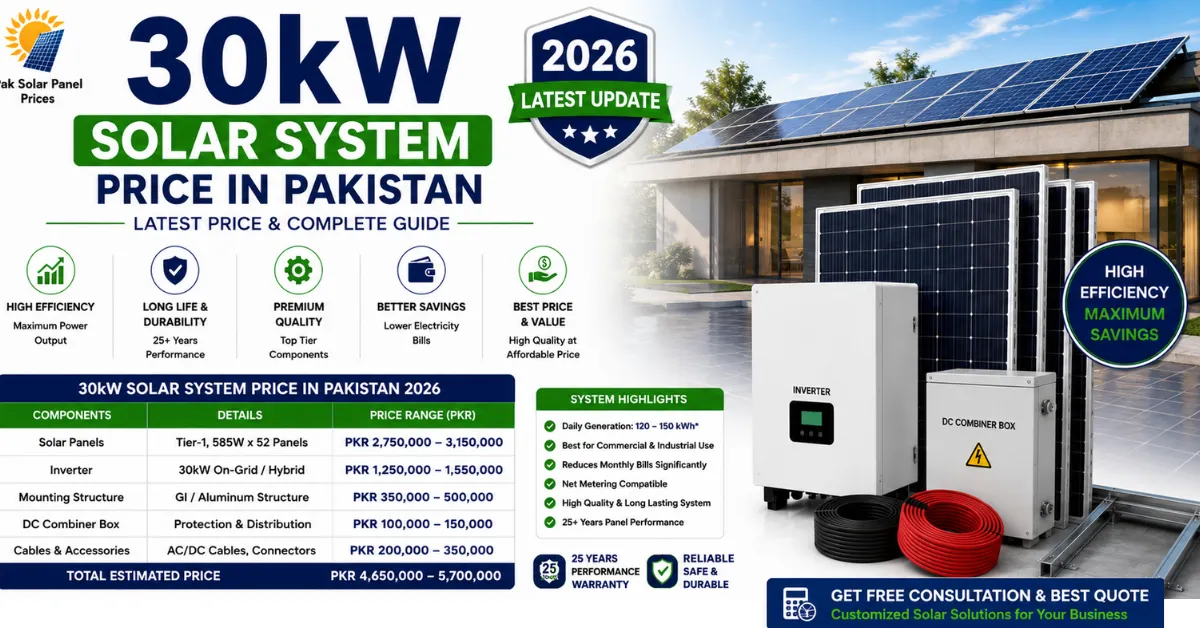
30kW Solar System Price in Pakistan 2026 – Latest Cost & Packages
A 30kW solar system sits firmly in commercial and industrial territory, though it’s equally common on very large residential properties big villas, farmhouses, and joint-family compounds with genuinely heavy daily electricity use. It’s the size for buyers who’ve moved past “will this cut my bill” and into “this needs to replace a serious chunk of grid dependency.“
30kW Solar System Price Range
|
System Type |
Price Range (PKR) |
|---|---|
|
On-grid |
2,253,000 – 3,250,000 |
|
Hybrid, no battery |
3,491,000 – 3,837,000 |
|
Hybrid + battery backup |
5,500,000 – 8,500,000+ |
The gap between on-grid and hybrid widens further at this scale, since a genuinely useful battery bank for a 30kW system represents a major standalone investment not an incremental add-on like it is at 5kW or 6kW.
Who Installs a 30kW Solar System?
Output You Can Expect
|
Metric |
Estimate |
|---|---|
|
Daily generation |
120 – 150 units (kWh) |
|
Monthly generation |
3,600 – 4,500 units |
|
Suitable for |
Large homes, medium businesses, or commercial facilities with high daytime draw |
Actual output depends on your city’s sunlight hours (Pakistan averages 5.5–6.5 peak sun hours), panel efficiency, and how well the installation is oriented a poorly angled or partially shaded array can fall well short of these numbers.
Read More: Solar System on Installments in Pakistan 2026 – Easy Monthly Installment Plans
Panel Count Varies More Than You’d Expect
|
Panel Wattage |
Approx. Panel Count for 30kW |
|---|---|
|
350W – 400W (older, low-wattage) |
75 – 85 panels |
|
540W – 580W (standard current) |
52 – 56 panels |
|
585W – 630W (high-wattage) |
48 – 51 panels |
Here’s something that catches buyers off guard at this size: both a 48-panel and an 85-panel system can technically deliver 30kW, but they need very different amounts of roof space and structural support. Always ask for the exact panel count and wattage rather than assuming all 30kW quotes involve a similar physical footprint this affects mounting cost, roof space requirements, and even how straightforward future maintenance will be.
Inverter Configuration Options
|
Configuration |
Pros |
|---|---|
|
Single large 30kW inverter |
Simpler wiring, typically lower cost |
|
Multiple smaller inverters (e.g., 3× 10kW) in parallel |
Redundancy one failure doesn’t stop generation entirely |
Most inverters at this size are hybrid-ready even in on-grid installations, meaning batteries can often be added later without replacing the core system worth confirming with your installer if you want to defer that cost.
Component Overview 30kW Solar System
A typical premium 30kW package includes:
Why “30kW” Quotes Can Differ by Over a Million Rupees
At this scale, quote variation isn’t just about brand preference it reflects real differences in scope:
A Reality Check on Payback Claims
Be cautious of blanket claims like “pays back in 15–18 months” attached to large systems that timeline generally applies only to large industrial users consuming well over 30,000 kWh a month at commercial tariff rates. For a typical large residential or mid-sized commercial 30kW installation, a more realistic payback window is 2.5–4 years, depending on your specific tariff slab and how much of the daytime generation you actually consume versus export.
Net Billing Note (2026)
Pakistan’s 2026 shift to a net billing framework applies here as it does at every other system size exported surplus is bought back at a separate rate rather than swapped unit-for-unit. At 30kW, where daytime surplus can be very large for sites with lighter daytime operations, this makes self-consumption planning genuinely important: shifting heavy loads (machinery, tube wells, cold storage cycles) to daylight hours captures more value than exporting ever will under the current rules.
Latest Post
- itel Lithium Battery 24V Price in Pakistan 2026 – Latest Price, Specifications & Buying Guide
- Install Solar Panels Cost in Pakistan 2026 – Complete Guide
- Solar Geyser Price in Pakistan
- Millat Battery Price in Pakistan 2026
- Solar Geyser Price in Pakistan 2026 – Latest Rates, Types & Buying Guide
Conclusion
A 30kW Solar System represents a serious infrastructure investment rather than a simple upgrade budget PKR 2,250,000–3,250,000 for a solid on-grid system, and expect hybrid battery backup to add several million more if full independence matters for your operation. Given how much quote scope can vary at this size, insist on exact panel count, wattage, genuine inverter rating, and complete documentation before comparing any two numbers side by side.



 Join Channel