

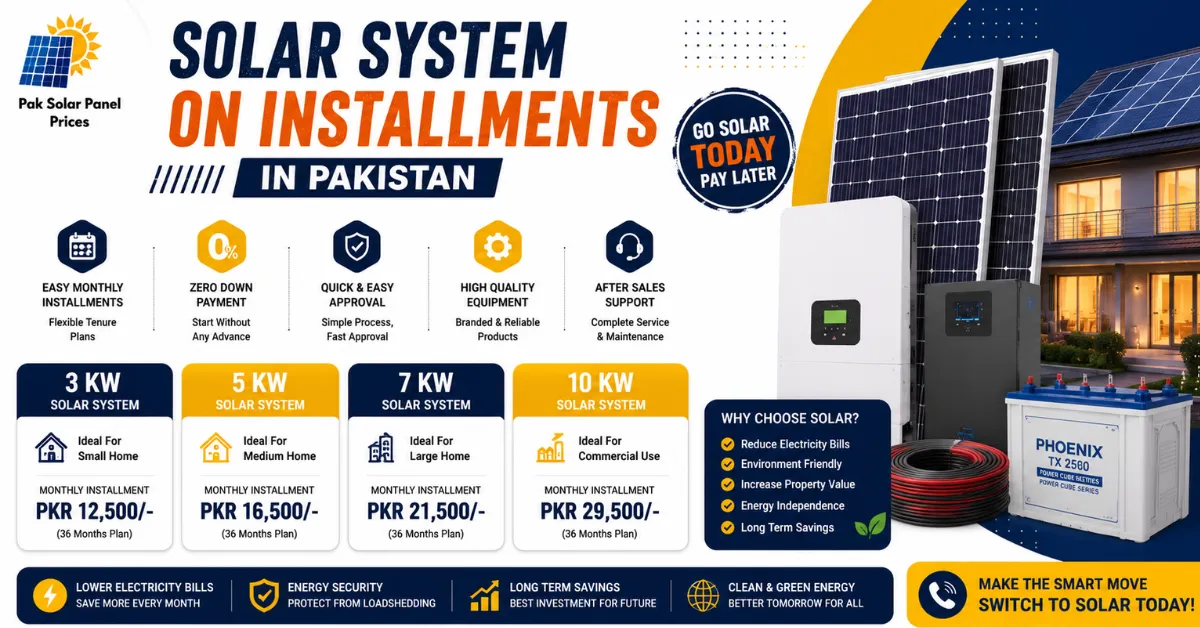
Solar System on Installments in Pakistan 2026 – Easy Monthly Installment Plans
Pakistan’s electricity bills have crossed Rs. 60 per unit in most DISCO zones. Load shedding in rural areas runs 8 to 12 hours daily. For millions of Pakistani households, solar energy is no longer a luxury it is a financial necessity.
But a quality 5kW solar system costs around PKR 7 to 10 lakh upfront. Most families cannot write that cheque in one go. That is exactly where solar installment financing comes in.
Here is what most people miss: if your monthly electricity bill is PKR 20,000 or more, you are already paying for a solar system just to your DISCO, month after month, without ever owning anything. Solar financing lets you redirect that same money toward a system you will own outright in 3 to 7 years and then enjoy near-zero electricity costs for the next 20+ years.
This guide covers every major bank offering Solar System on Installment in 2026, their rates, eligibility criteria, required documents, and exactly how to apply.
Quick Comparison – Solar Financing Banks in Pakistan 2026
| Bank | Type | Markup Rate | Max Financing | Tenure | Min. Income | Approval Time |
|---|---|---|---|---|---|---|
| Meezan Bank | Islamic (Diminishing Musharakah) | 6% (SBP) / 20–24% commercial | PKR 30 Lakh | Up to 7 years | PKR 50,000/month | 21–35 working days |
| Bank Alfalah | Conventional + Islamic window | 6% (SBP) / 18–22% commercial | PKR 40 Crore | Up to 7 years | PKR 100,000/month | 7–14 working days |
| JS Bank | Conventional + Islamic option | 18–23% (commercial) | PKR 1 Crore | Up to 7 years | PKR 40,000/month | 10–18 working days |
| Faysal Bank | Islamic (Diminishing Musharakah) | 6% (SBP) / 19–23% commercial | PKR 30 Lakh | Up to 7 years | PKR 50,000/month | 12–25 working days |
| HBL | Conventional + Agricultural | 6% (SBP) / KIBOR-linked | PKR 50 Lakh+ | Up to 7 years | PKR 60,000/month | 14–21 working days |
| Allied Bank | Conventional | KIBOR + Spread / 6% SBP | PKR 30 Lakh | Up to 7 years | PKR 50,000/month | 10–15 working days |
⚠️ Important Note: The 6% SBP Refinance Rate is available through the State Bank of Pakistan’s Renewable Energy Refinance Scheme. However, each bank has a limited SBP allocation that runs out quickly. Once exhausted, banks lend at commercial rates (typically 17–24%). Always ask your bank whether the SBP rate is currently available when you apply.
Read More: Fronus Inverter Price in Pakistan 2026 – Latest Models, Specifications & Buying Guide
What Is the SBP Solar Financing Scheme?
The State Bank of Pakistan (SBP) Renewable Energy Refinance Scheme is the backbone of solar installment financing in Pakistan. Under this scheme, SBP provides subsidized refinancing to commercial banks, enabling them to offer solar loans at a significantly reduced markup rate of 6% per annum instead of the standard commercial rate of 17–24%.
The scheme covers solar systems ranging from 1kW to 1MW across residential, commercial, industrial, and agricultural applications. Any Pakistani citizen with a CNIC who owns property can apply through a participating bank.
The goal is simple: make solar energy financially accessible to every segment of the Pakistani economy from a homeowner in Multan to a textile factory in Karachi.
Bank-by-Bank Guide to Solar System on Installment Financing
1. Meezan Bank – Best for Islamic/Shariah-Compliant Financing
Meezan Bank is Pakistan’s largest Islamic bank and the most popular solar financing choice in the country. If Shariah compliance is important to you, Meezan is the default answer the entire solar industry will give you.
- Financing: PKR 1 Lakh to PKR 30 Lakh
- Tenure: 1 to 7 years
- Markup: 6% (SBP rate, subject to availability) or 20–24% commercial
- Mode: Islamic (Diminishing Musharakah / Ijarah)
- Meezan Bank account: mandatory (opened if you do not have one)
- Pakistani citizen, age 20–60 years
- Salaried: Minimum income PKR 50,000/month, 3 years at current employer, 5 years total experience
- Self-employed/Business: Minimum 30 years age, 2+ years business history, NTN required
- Active taxpayer with NTN number
- Property must be owned by applicant or immediate family member
- No financing for flats/apartments
Read More: Maryam Nawaz Solar Panel Scheme 2026 Registration & Latest Updates
2. Bank Alfalah – Best for Commercial & Large Systems
Bank Alfalah is Pakistan’s go-to bank for commercial-scale solar financing. Its PKR 40 Crore ceiling makes it the default choice for factories, SMEs, and large residential installations that other banks cannot accommodate.
- Financing: PKR 5 Lakh to PKR 40 Crore
- Tenure: 6 months to 7 years
- Markup: 6% (SBP rate) or 18–22% commercial
- Mode: Conventional + Islamic window (Alfalah Mufeed Diminishing Musharakah/Ijarah)
- System size: 4kW to 100kW (residential), up to MW-scale (commercial)
- Salaried: Permanent employee, minimum income PKR 100,000/month
- Non-objection certificate from all owners if joint property
- Installment amount should not exceed 30% of 3-month peak electricity bill average
- Property ownership documents or NOC required
- Fastest approval among major banks: 7–14 working days
- Separate solar underwriting team (since 2024) faster processing than general personal loans
- Accepts digital income verification
- Net metering eligible you can sell excess electricity back to WAPDA
Read More: 5kW Solar Inverter Price in Pakistan 2026 – Latest Prices, Top Brands & Buying Guide
3. JS Bank – Best for Lower-Income Salaried Buyers
JS Bank was one of the first banks in Pakistan to launch a dedicated solar financing product (2018), giving it more experience than most competitors. Its biggest advantage is the lowest minimum income threshold making solar accessible to buyers that other banks turn away.
- Financing: Up to PKR 1 Crore
- Tenure: Up to 7 years
- Markup: 18–23% (commercial) | 6% when SBP allocation available (rare as of mid-2026)
- Mode: Conventional + Islamic option (JS Islamic window)
- Minimum income: PKR 40,000/month lowest on this list
4. Faysal Bank – Best for Self-Employed & Business Owners
Faysal Bank completed its full conversion to Islamic banking in 2024 and has positioned itself as a green energy leader. Its biggest differentiation is flexibility for self-employed applicants a huge segment in Pakistan that conventional banks struggle to finance.
- Financing: Up to PKR 30 Lakh
- Tenure: Up to 7 years
- Markup: 6% (SBP rate) or 19–23% commercial
- Mode: Islamic (Diminishing Musharakah fully Shariah-compliant since 2024 conversion)
- Dedicated Green Financing Division
Read More: Jinko Tiger Neo 585W Solar Panel Price in Pakistan 2026 | Latest Market Rates
5. HBL – Best for Farmers and Agricultural Use
HBL (Habib Bank Limited) offers a particularly strong financing product for agricultural users. If you want to install solar for a tubewell, agricultural pump, or farm operation, HBL is the most practical option because it offers quarterly and bi-annual installment schedules that align with harvest income cycles rather than monthly payments that do not match farmers’ cash flows.
- Financing: Up to PKR 50 Lakh+
- Tenure: Up to 7 years
- Markup: 6% (SBP rate) or KIBOR-linked commercial rate
- Installment options: Monthly, quarterly, or bi-annual (agriculture only)
- Minimum income: PKR 60,000/month (salaried)
6. Allied Bank – Solar System Finance
Allied Bank offers a straightforward conventional solar loan with one of the longest available tenures in Pakistan.
- Financing: PKR 2 Lakh to PKR 30 Lakh
- Tenure: Up to 7 years (longest standard tenure on this list)
- Markup: 6% (SBP) or KIBOR + Spread (commercial)
- Minimum equity contribution: 30% of total project cost (down payment)
- No hidden charges
- Early repayment allowed (charges apply as per bank schedule)
Best For: Buyers who want a longer repayment period to keep monthly EMI as low as possible
EMI Calculator – What Will Your Monthly Payment Be?
Here are realistic EMI examples based on common system sizes and financing amounts:
| System Size | Approx. Cost | Down Payment (20–30%) | Financed Amount | EMI at 6% (7 yrs) | EMI at 18% (5 yrs) |
|---|---|---|---|---|---|
| 3kW | PKR 5–6 Lakh | PKR 1.25 Lakh | PKR 4.75 Lakh | ~PKR 6,900 | ~PKR 12,000 |
| 5kW | PKR 8–10 Lakh | PKR 2 Lakh | PKR 8 Lakh | ~PKR 11,600 | ~PKR 20,200 |
| 7kW | PKR 12–14 Lakh | PKR 3 Lakh | PKR 11 Lakh | ~PKR 16,000 | ~PKR 27,800 |
| 10kW | PKR 16–20 Lakh | PKR 4 Lakh | PKR 16 Lakh | ~PKR 23,200 | ~PKR 40,400 |
The key point: under Pakistan’s 2026 electricity tariffs, your monthly EMI at the SBP 6% rate is often lower than the electricity bill your solar system will replace — making you financially net-positive from day one.
Documents Required for Solar Financing in Pakistan
Almost all banks require the following standard documents. Gather these before you apply to avoid delays:
- Copy of CNIC (applicant + co-applicant if any)
- Last 12 months of electricity bills (proves consumption level and justifies system size)
- Property ownership documents (title deed, registry, or allotment letter)
- Solar quotation from an authorized vendor registered with the bank
- Salary slips (last 3–6 months)
- Employment letter from HR/employer
- Bank statements (last 6–12 months)
- NTN number (active taxpayer)
- Bank statements (last 12 months)
- Business registration documents
- Audited financials or tax returns
- NTN number (mandatory)
- Land ownership documents or tenancy agreement
- Agricultural income proof
- Khasra/fard documents
Step-by-Step: How to Apply for Solar Financing in Pakistan
Who Is Eligible for Solar Financing in Pakistan?
The basic eligibility requirements set by the State Bank of Pakistan are simple and apply across all participating banks:
- Pakistani citizen with a valid CNIC
- Property owner the solar system must be installed on property you own (or with NOC from owner)
- Stable income varies by bank (Rs. 40,000 to Rs. 100,000/month depending on institution)
- Good credit history banks check your eCIB report; overdue payments or defaults will affect approval
- Active taxpayer NTN number required by most banks
Flats and apartments are generally not eligible at most banks (including Meezan). If you live in an apartment, check specifically with JS Bank or Bank Alfalah about exceptions.
Islamic vs. Conventional Solar Financing — What Is the Difference?
| Feature | Islamic Financing | Conventional Financing |
|---|---|---|
| Structure | Diminishing Musharakah or Ijarah | Interest-based installment loan |
| Interest (Riba) | None bank earns profit on asset share | Standard markup/interest applies |
| Available at | Meezan, Faysal, Allied Islamic, Alfalah Islamic | JS Bank, HBL, Allied Bank, Bank Alfalah |
| Markup Rate | Similar (6% SBP / 19–24% commercial) | Similar (6% SBP / 17–23% commercial) |
| Shariah Compliance | Yes certified by bank’s Shariah board | No |
| Who Should Choose | Anyone prioritizing halal financing | Anyone comfortable with conventional banking |
The monthly EMI looks very similar between both structures at the same rate and tenure. The difference is in the underlying contract Islamic financing involves co-ownership of the asset, not a loan with interest.
Government Initiatives for Free & Subsidized Solar
Beyond bank financing, Pakistan has several government programs worth knowing about:
Common Mistakes to Avoid When Applying
Frequently Asked Questions (FAQs)
Q: Can I get a solar system on installments without a down payment?
Most banks require 20–30% down payment. Some solar companies (not banks) advertise zero down payment schemes these are company-level offers with higher monthly costs. Always read the full terms before committing.
Q: Which bank is best for solar financing in Pakistan?
Meezan Bank for Islamic financing and salaried professionals. Bank Alfalah for commercial/large systems. JS Bank for lower-income salaried buyers. Faysal Bank for self-employed applicants. HBL for agricultural users.
Q: Is solar financing halal?
Yes if done through Meezan, Faysal, or the Islamic windows of other banks using Diminishing Musharakah or Ijarah structures. These are certified Shariah-compliant by the respective banks’ Shariah boards.
Q: How long does approval take?
Bank Alfalah is fastest at 7–14 working days. JS Bank takes 10–18 days. Meezan takes 21–35 days. Having complete documentation from day one speeds up the process significantly.
Q: Can self-employed people get solar financing?
Yes Faysal Bank is specifically designed for self-employed applicants. Meezan and others are stricter on documentation for self-employed buyers.
Q: Are batteries included in solar financing?
Most banks (including Meezan) do not finance batteries only panels, inverters, and installation. Faysal Bank and some others may accommodate hybrid systems. Confirm with your bank before applying.
Q: What happens if I miss a payment?
Late fees apply as per the bank’s schedule. Repeated missed payments affect your eCIB credit score and can result in legal action by the bank. Always ensure your EMI is within 30–33% of your monthly income.
Q: Can I sell extra electricity back to the grid while on a financing plan?
Yes. Net metering is independent of your financing arrangement. Once your system is AEDB-certified and net metering is registered, you can sell surplus electricity to your DISCO at Rs. 19–21 per unit which effectively reduces your net monthly cost further.
Is Solar Financing Right for You?
If you are paying more than PKR 15,000 per month in electricity bills, solar financing almost certainly makes financial sense. Here is a simple way to think about it:
- Your current bill of PKR 20,000/month = Rs. 2,40,000 per year going to WAPDA
- A financed 5kW system EMI at 6% SBP rate = approximately PKR 11,600/month
- Monthly saving from day one = PKR 8,400+
- After 7 years (loan fully paid): near-zero electricity cost for the remaining 18+ years of the system’s life
The math strongly favors buyers with high monthly bills. The higher your current bill, the faster the payback, and the stronger the case for financing a system now rather than waiting.

 Join Channel