

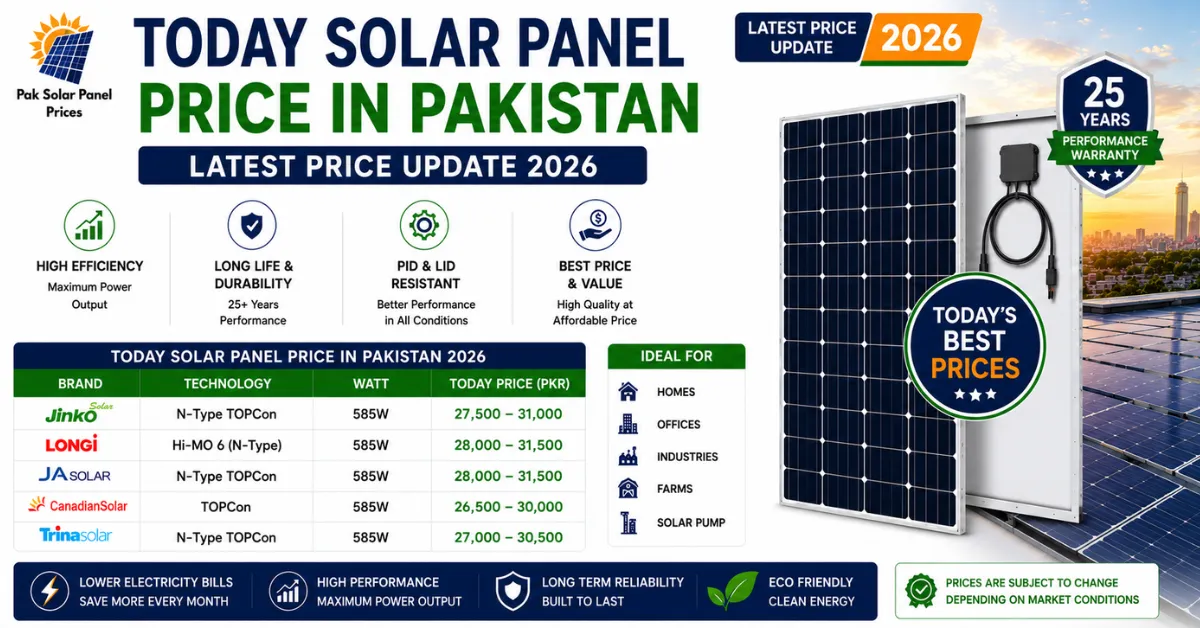
Today Solar Panel Price in Pakistan 2026 Latest Price Updates
How much does a solar panel cost in Pakistan today? Today A-grade solar panels in Pakistan generally cost between PKR 27 and PKR 45 per watt, depending on cell technology and brand. Pakistan’s energy landscape has shifted dramatically. With electricity tariffs climbing past Rs. 60 per unit in many distribution zones and load-shedding still disrupting daily life, hundreds of thousands of homeowners, farmers, and business owners are moving toward solar energy not as a luxury, but as a practical financial decision.
Yet the most common question remains the same: what is the actual Today solar panel price in Pakistan?
Solar Panel Price in Pakistan guide answers that question with real, updated market data covering every major brand, every popular system size, and every major city. Whether someone is buying their first solar panel or upgrading an existing setup, this resource gives them the numbers and the context to make a confident purchase.
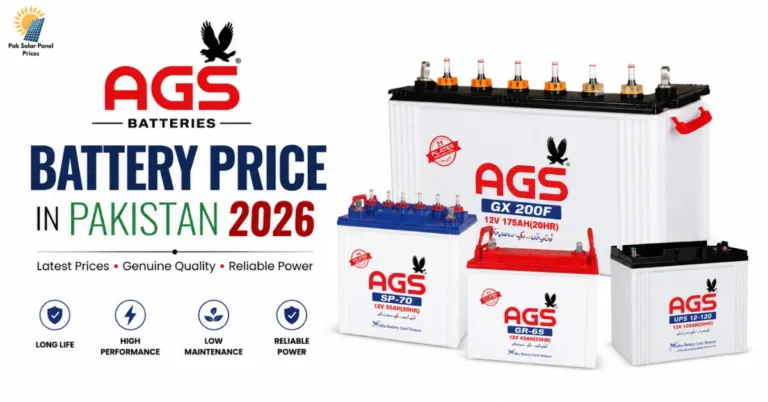
Read More: AGS Battery Price in Pakistan 2026 – Latest Price List, Models & Buying Guide
Solar Panel Price in Pakistan Today Updates 2026
The table below reflects verified A-Grade, Tier-1 N-Type market reference rates as of 2026. These are wholesale-to-dealer rates final customer prices may vary by Rs. 2 to Rs. 5 per watt depending on city, dealer margin, documentation, and stock batch.
| Brand | Technology | Price Per Watt (PKR) | Grade |
|---|---|---|---|
| LONGi Hi-Mo X10 HPBC 2.0 | N-Type HPBC | Rs. 45–49 | A-Grade Tier-1 |
| Jinko Tiger Neo N-Type Bifacial | N-Type TOPCon | Rs. 44–47 | A-Grade Tier-1 |
| JA Solar N-Type Bifacial | N-Type TOPCon | Rs. 44–45 | A-Grade Tier-1 |
| Canadian Solar TopCon / HJT | N-Type HJT | Rs. 48–51 | A-Grade Tier-1 |
| Trina Solar N-Type Mono | N-Type TOPCon | Rs. 42–44 | A-Grade Tier-1 |
| AstroNergy N-Type Bifacial 20BB | N-Type TOPCon | Rs. 40–42 | A-Grade Tier-1 |
| Inverex N-Type HJT Bifacial | N-Type HJT | Rs. 40–44 | A-Grade Tier-1 |
| Crown N-Type Bifacial | N-Type TOPCon | Rs. 38–42 | A-Grade |
| A-Grade P-Type Monofacial (Generic) | P-Type PERC | Rs. 28–36 | A-Grade |
| B-Grade Panels (Any Brand) | Mixed | Rs. 18–28 | B-Grade |
Important Disclaimer: These are reference market rates, not fixed selling prices. Always confirm directly with a verified importer or authorized dealer before finalizing any purchase. Prices update daily based on market conditions.
Read More: Solis Inverter Price in Pakistan 2026 – Latest Models, Features & Complete Buying Guide
Brand-by-Brand Today Solar Panel Price In Pakistan 2026
1. LONGi Solar Panel
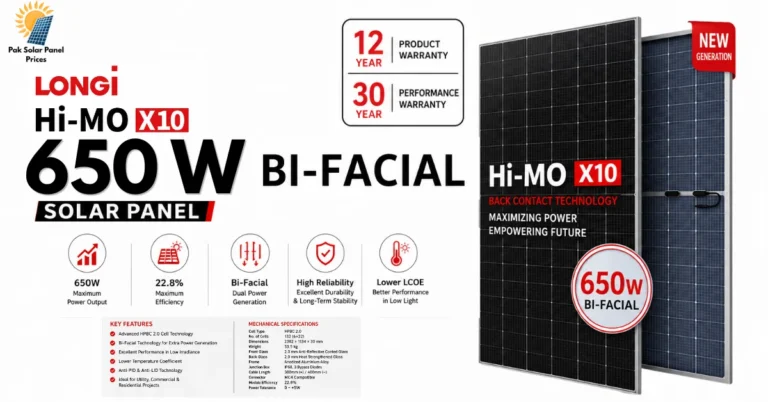
LONGi is the world’s largest monocrystalline silicon producer and one of the most trusted names in Pakistan’s solar market. Their Hi-Mo series particularly the Hi-Mo 7 and the flagship Hi-Mo X10 HPBC 2.0 dominates residential installations across Punjab, Sindh, and KPK.
The Hi-Mo X10 features HPBC 2.0 (Hybrid Passivated Back Contact) technology with anti-glare, anti-shading capabilities currently one of the most advanced cell technologies available in Pakistan. Its efficiency reaches up to 23.1% under standard test conditions.
Current Longi Price Range in Pakistan 2026:
2. Jinko Solar
Jinko Solar has the strongest distribution network in Pakistan. Finding genuine, documented Jinko panels is rarely a challenge, which is a key practical advantage. Their Tiger Neo N-Type series is currently the most popular choice for both residential and commercial setups.
Jinko N-Type panels deliver efficiency up to 22.5%, with degradation rates well under 0.4% annually. For homeowners who plan to apply for net metering, Jinko’s documentation trail and IEC certification make the NEPRA approval process straightforward.
Current Jinko Price Range in Pakistan 2026:
3. Canadian Solar Panel
Canadian Solar carries two decades of global manufacturing reputation. Their HiKu7 series (TOPCon) and HiHero series (HJT) represent the premium tier of the Pakistani market. HJT panels achieve efficiency ratings up to 23.3%, making them among the most space-efficient options available ideal for homes with limited roof area.
The brand commands a price premium, but that premium also translates into better resale value for properties where the system will be sold along with the home.
Current Canadian Solar Price Range in Pakistan 2026:
4. JA Solar Panel
JA Solar consistently delivers the strongest cost-per-watt proposition among Tier-1 brands in Pakistan. Their N-Type Bifacial panels offer efficiency comparable to Jinko and LONGi at a slightly more accessible price point making them the preferred choice for budget-conscious buyers who refuse to compromise on quality.
Current JA Solar Price Range in Pakistan 2026:
Trina Solar Panel
Trina Solar pioneered the large-format panel format. Their Vertex N series offers panels above 600W per unit, which reduces the total number of panels needed on the roof and lowers installation labor costs. Trina also stands out with a 15-year product warranty the longest among all brands covered in this guide.
Current Trina Solar Price Range in Pakistan 2026:
5. AstroNergy — A-Grade N-Type Option
AstroNergy (formerly CHINT Astro) offers A-Grade, Tier-1 certified N-Type TOPCon and Bifacial panels at one of the most competitive price points in the market. For buyers who want documented N-Type technology without paying the LONGi or Canadian premium, AstroNergy represents exceptional value.
Current AstroNergy Price Range in Pakistan 2026:
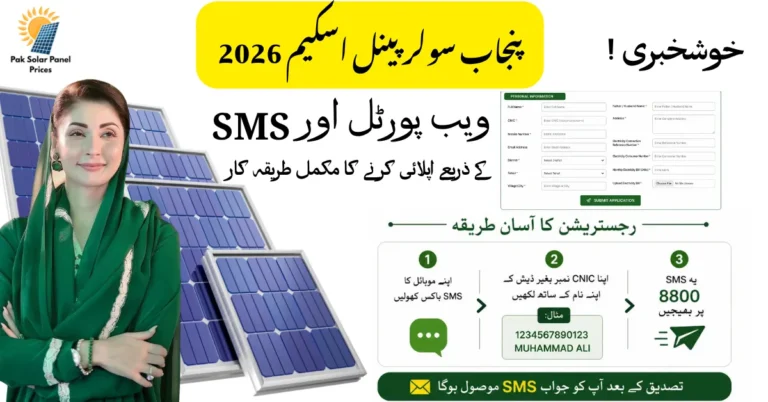
Read More: Maryam Nawaz Solar Panel Scheme 2026 Registration & Latest Updates
3kW Solar System Price in Pakistan 2026
A 3kW system suits small homes and apartments with monthly electricity consumption between 250 and 450 units. It can comfortably support fans, LED lighting, a refrigerator, water pump, and a small television.
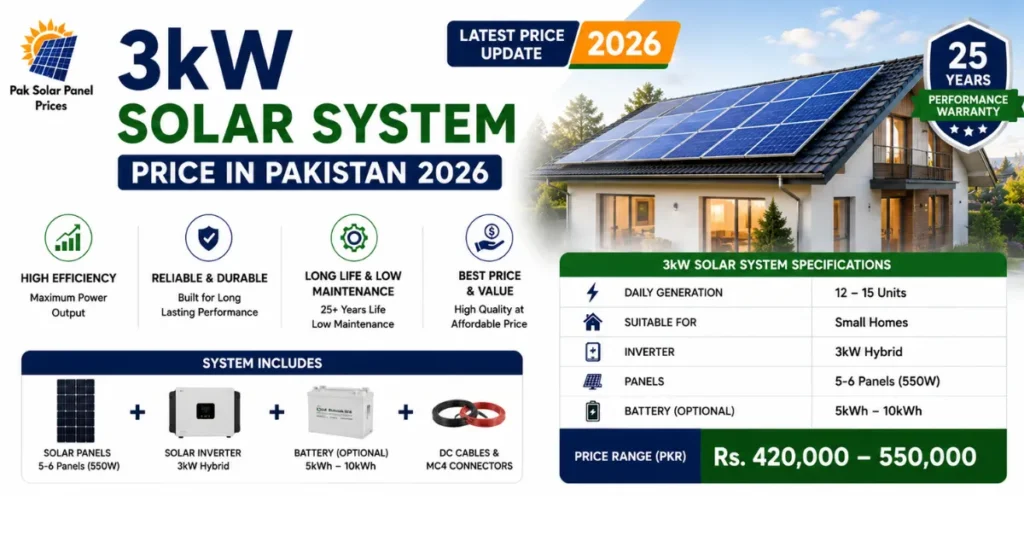
| System Type | Price Range (PKR) |
|---|---|
| On-Grid (No Battery) | Rs. 350,000 – 450,000 |
| Hybrid (With Battery) | Rs. 500,000 – 700,000 |
- Daily production: 10–14 units
- Panels needed: 5–6 × 550W panels
- Payback period: 3.5–4.5 years
- Recommended for: Small apartments, starter homes, families with 1 AC or none
5kW Solar System Price in Pakistan 2026
The 5kW system is Pakistan’s single most popular system size. It handles a full medium-sized home one or two 1-ton inverter ACs, refrigerator, washing machine, water pump, fans, LED lighting, and basic office equipment.
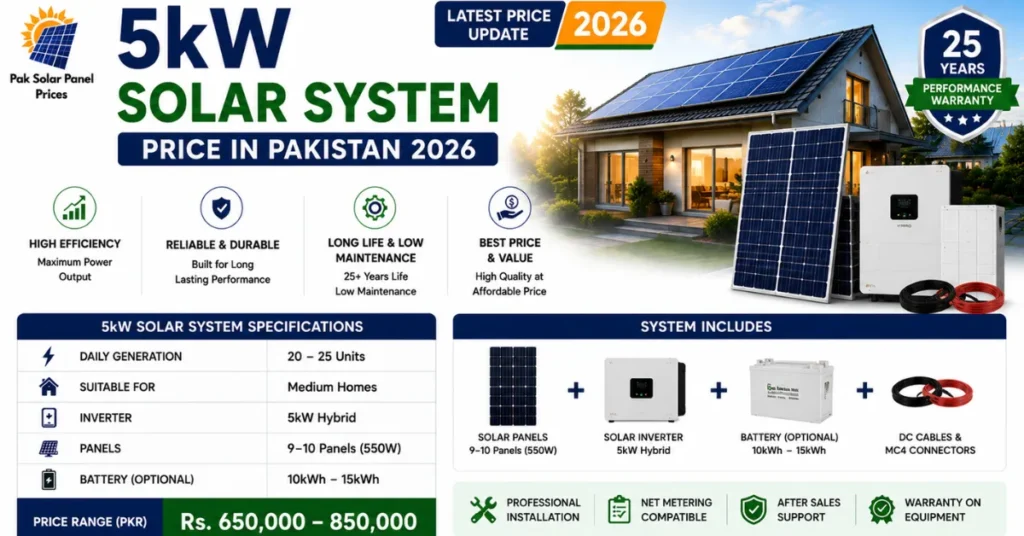
| System Type | Price Range (PKR) |
|---|---|
| On-Grid (No Battery) | Rs. 600,000 – 800,000 |
| Hybrid (With Battery) | Rs. 900,000 – 1,200,000 |
- Daily production: 18–25 units
- Panels needed: 8–10 × 550W–580W panels
- Payback period: 3–4 years
- Recommended for: Average Pakistani household, 2–3 bedroom home
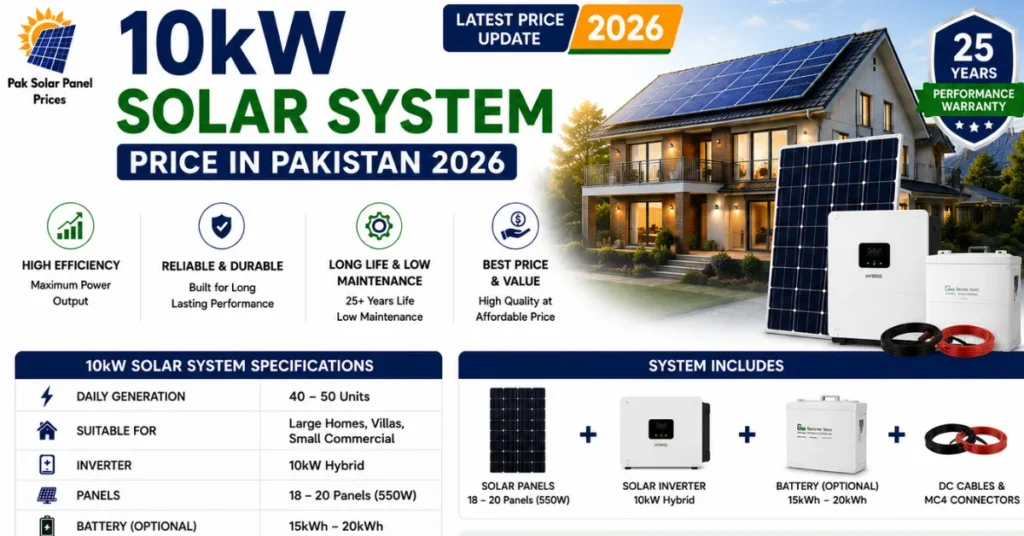
10kW Solar System Price in Pakistan 2026
A 10kW system is designed for large houses, joint families, dual-income households, or small businesses. It can support multiple inverter ACs simultaneously along with all standard home appliances during daylight hours.
| System Type | Price Range (PKR) |
|---|---|
| On-Grid (No Battery) | Rs. 950,000 – 1,200,000 |
| Hybrid (With Battery) | Rs. 1,400,000 – 1,700,000 |
- Daily production: 35–45 units
- Panels needed: 16–18 × 580W–600W panels
- Payback period: 3–4.5 years
- Recommended for: Large homes, 3–4 ACs, home offices, small commercial setups
15kW–20kW Solar System Price in Pakistan 2026
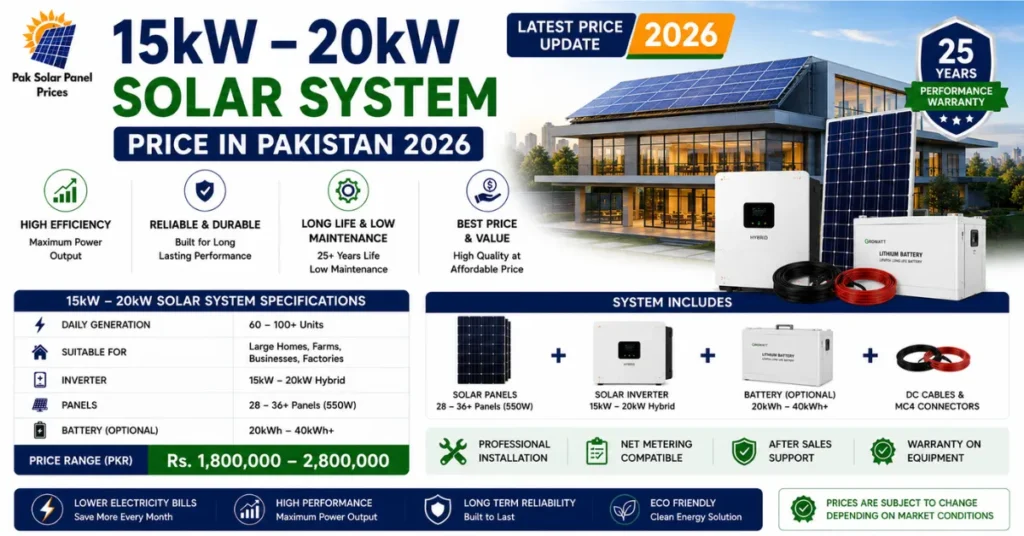
These system sizes serve large commercial properties, industrial facilities, agricultural tubewells, schools, hospitals, and luxury residential compounds.
| System Size | On-Grid Price Range (PKR) | Hybrid Price Range (PKR) |
|---|---|---|
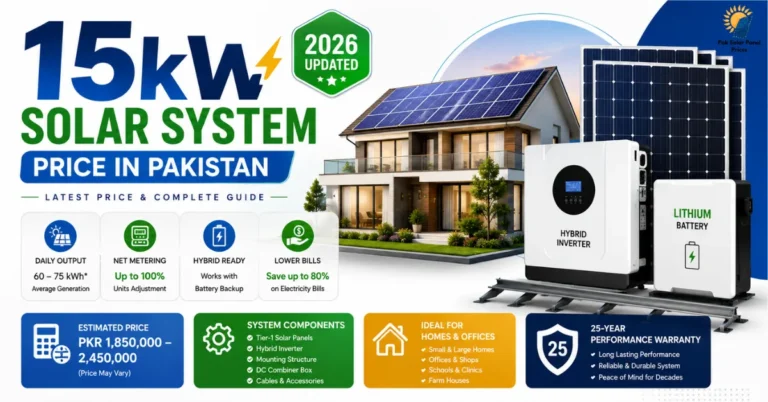
| 15kW | Rs. 1,500,000 – 1,900,000 | Rs. 2,200,000 – 2,800,000 |
| 20kW | Rs. 1,800,000 – 2,300,000 | Rs. 2,800,000 – 3,500,000 |
City Wise Solar Panel Prices in Pakistan 2026
Regional price differences in Pakistan are driven by port proximity, dealer competition, local demand, and transport logistics.
| City | A-Grade N-Type Price Range (Per Watt) | DISCO Zone |
|---|---|---|
| Karachi | Rs. 39–42 | K-Electric |
| Lahore | Rs. 40–43 | LESCO |
| Faisalabad | Rs. 40–43 | FESCO |
| Multan | Rs. 40–44 | MEPCO |
| Islamabad / Rawalpindi | Rs. 41–44 | IESCO |
| Peshawar | Rs. 42–47 | PESCO |
| Quetta | Rs. 42–47 | QESCO |
| Hyderabad | Rs. 38–42 | HESCO |
Why Karachi is cheapest: Karachi is Pakistan’s primary import hub. Panels arrive directly at Karachi Port, eliminating long-haul inland transportation costs. More importers compete in Karachi’s wholesale market Hall Road Lahore and College Road Rawalpindi are the next most competitive markets.
Why northern cities pay more: Distance from ports, fewer distributors, and smaller order volumes increase the cost per panel for dealers in KPK and Balochistan.
Read More: 5kW Solar Inverter Price in Pakistan 2026 – Latest Prices, Top Brands & Buying Guide
On-Grid vs. Hybrid vs. Off-Grid — Which System Makes Sense?
On-Grid Systems
These connect directly to the national grid without any battery backup. Excess electricity generated during the day is exported to the grid through net metering. On-grid systems are the most affordable option and offer the fastest payback period. However, they do not provide power during grid outages a significant drawback in areas with heavy load-shedding.
Best for:
Areas with 4 hours or less of load-shedding per day and reliable DISCO service.
Hybrid Systems
Hybrid systems include battery storage, allowing excess solar energy to be stored and used during outages or at night. They cost 35–50% more than on-grid systems but provide continuous power regardless of grid availability a major advantage in Punjab, KPK, and interior Sindh where load-shedding remains severe.
Best for:
Households with 5+ hours of daily load-shedding, or anyone requiring uninterrupted power for medical equipment, refrigeration, or home offices.
Off-Grid Systems
These operate entirely independently from the grid and rely fully on battery storage. They are typically used in remote agricultural areas, construction sites, or rural communities without grid access. Off-grid systems have the highest upfront cost and are not recommended for urban homes where grid connection is available, as the cost per unit generated is significantly higher.
Best for:
Agricultural tubewells, remote farmhouses, rural villages.
How to Choose the Right Solar Panel Buyer’s Guide
Step 1 Assess Monthly Consumption:
Review the last 12 months of electricity bills. Calculate the average monthly units consumed. This figure directly determines the system size needed.
Step 2 Choose System Type:
If the monthly bill is below Rs. 8,000, solar ROI may be slower. Above Rs. 10,000–15,000 per month, a hybrid system typically recovers its cost within 3–4 years.
Step 3 Select Panel Technology:
For long-term investment, N-Type bifacial panels are strongly recommended despite their higher upfront cost. Lower annual degradation means more energy production in years 10–25.
Step 4 Verify Documentation:
Before purchasing any panel, ask for the IEC certification, brand warranty card, and import documentation. Undocumented panels complicate net metering applications and void most manufacturer warranties.
Step 5 Get Multiple Quotes:
Never finalize a solar installation based on a single quotation. Compare at least three verified dealers or certified installers. Ask each quote to separately break down panel cost, inverter cost, structure and wiring, installation labor, and net metering charges.
Step 6 Check Installer Credentials:
Only work with AEDB-certified installers or companies registered with the relevant DISCO. An uncertified installation can prevent net metering approval and may create legal complications in the future.
Net Metering in Pakistan What Buyers Need to Know in 2026?
Net metering allows solar system owners to export surplus electricity to the grid and receive a credit on their monthly bill. In 2026, NEPRA revised its Prosumer Regulations a change buyers must understand before investing.
Under the updated framework, self-consumed solar electricity delivers maximum value (every unit consumed replaces a purchased unit at the full tariff rate of Rs. 33–48 depending on slab). Exported units, however, are credited at a lower buy-back rate. This means the economic argument for solar is strongest for households who consume most of their solar production during daylight hours commercial establishments, home-based businesses, and families with daytime presence.
Read More: Maryam Nawaz Solar Panel Scheme 2026 Registration & Latest Updates
Government Solar Schemes in Pakistan 2026 Update
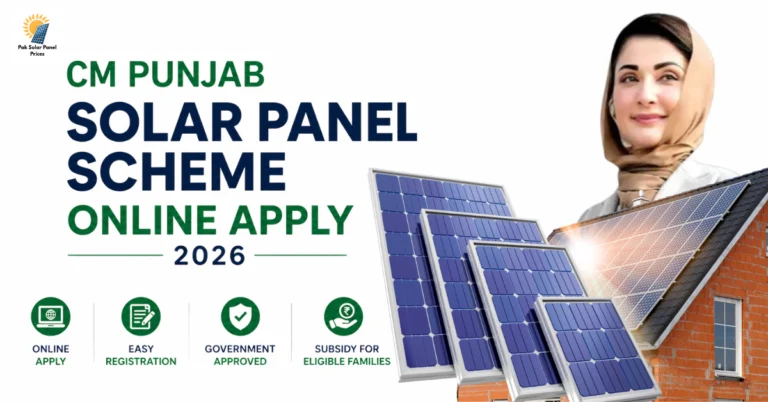
CM Punjab Free Solar Panel Scheme 2026:
This initiative remains active in 2026 for eligible households consuming up to 200 units per month. Eligible applicants can apply through their local DISCO (LESCO, FESCO, MEPCO) after solar installation. The scheme has been extended multiple times due to strong demand.
PM Roshan Gharana Program:
The federal government’s Roshan Gharana initiative targets low-income households with subsidized solar setups. Eligibility verification is conducted through the NSER (National Socio-Economic Registry).
SBP Renewable Energy Refinance Scheme:
The State Bank of Pakistan offers financing for solar systems at a markup rate as low as 6% annually. Banks including Meezan Bank (Shariah-compliant), JS Bank, and Bank Alfalah actively provide financing under this framework. A typical 5kW system financed under SBP’s scheme can yield monthly EMIs lower than the electricity bill it replaces from month one.
Solar ROI in Pakistan Is Solar Worth It in 2026?
The financial case for solar in Pakistan has never been stronger. With grid electricity rates exceeding Rs. 33–60 per unit depending on consumption slab, and solar panel prices at historic lows due to global photovoltaic oversupply, the return on investment equation has shifted decisively in favor of solar.
A properly installed 5kW hybrid system for a home with a Rs. 25,000 monthly electricity bill typically:
Common Mistakes to Avoid When Buying Solar Panels in Pakistan
Final Verdict Should You Buy Solar in Pakistan Right Now?
Yes and the timing is genuinely favorable. Today Solar Panel Price in Pakistan hit historic lows in 2026–2027 driven by global photovoltaic manufacturing oversupply, particularly from Chinese Tier-1 producers. At the same time, WAPDA and K-Electric tariffs have risen sharply, and load-shedding while reduced in some areas remains a daily reality for millions of households.
 Join Channel