

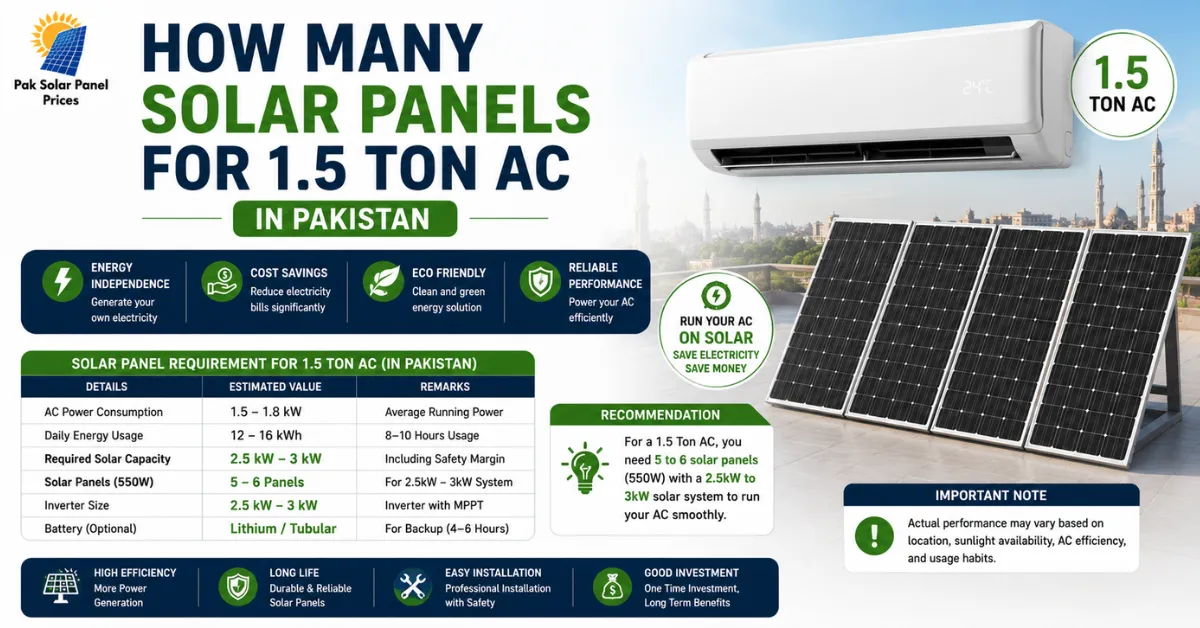
Solar Panel for 1.5 Ton AC in Pakistan 2026 – Panels Required, System Size & Cost
Every summer in Pakistan, the same question echoes across every household: Can I run my AC on solar? The answer is yes absolutely. Millions of Pakistani homes are already doing it. But the real question most people are actually asking is more specific: How many solar panels do I need for my 1.5 ton AC, and what will it cost me?
The confusion is understandable. Search online and you will find answers ranging from 4 panels to 10 panels and all of them are technically correct for different situations. The number depends on what type of AC you have, how many hours per day you run it, whether you want to run other appliances alongside it, and whether you need backup during load shedding. This guide untangles all of that. By the end, you will know the exact number of panels for your specific situation, the right system size, the complete cost, and what to watch out for when buying.
First: How Much Electricity Does a 1.5 Ton AC Actually Use?
Before counting panels, you need to understand what you are powering. The word “1.5 ton” describes cooling capacity not power consumption. A 1.5 ton AC can cool roughly 150–200 square feet of room space. The electricity it consumes is a separate figure that depends on the technology inside the unit.
Read More: Solis Inverter Price in Pakistan 2026 – Latest Models, Features & Complete Buying Guide
There are two types of 1.5 ton AC on the Pakistani market:
Inverter AC (Modern, Recommended for Solar)
An inverter AC adjusts its compressor speed based on how hot the room is. When the room first turns on, it runs at full power to reach your set temperature. Once it gets there, it slows down to 30–60% of maximum capacity to maintain it. This variable operation is what makes inverter ACs dramatically more efficient.
| Running Condition | Power Draw |
|---|---|
| Starting up (room very hot) | 1,800W – 2,200W (brief surge) |
| Full cooling load | 1,200W – 1,500W |
| Maintaining temperature | 600W – 900W |
| Average per hour (realistic) | 1,200W – 1,500W |
Non-Inverter AC (Fixed Speed, Old Technology)
A non-inverter AC runs at full power every time the compressor is on, then shuts off completely when the thermostat is satisfied. It then restarts at full power again cycling on and off repeatedly. This constant full-load cycling consumes 30–40% more electricity than an inverter AC doing the same cooling job.
| Running Condition | Power Draw |
|---|---|
| When compressor is ON | 2,000W – 2,400W (always full load) |
| When compressor is OFF | 0W |
| Average per hour (realistic) | 1,700W – 2,200W |
The most important advice in this article: If you currently have a non-inverter AC and are planning to install solar, replace the AC first. The energy you save from switching to an inverter AC reduces the number of solar panels you need and that saving pays for the new AC within 1–2 years.
How Many Solar Panels for a 1.5 Ton AC? The Direct Answer
The number varies depending on four things: your AC type, daily usage hours, whether you want to run other appliances alongside the AC, and your panel wattage. Here is a clear, organized breakdown:
Read More: Livoltek Inverter Price in Pakistan 2026 – Latest Models, Features & Buying Guide
If You Only Want to Run the AC (No Other Appliances)
| AC Type | Daily Usage | Panels Needed (585W each) | System Size |
|---|---|---|---|
| Inverter AC | 4–6 hours/day | 4 panels | 2.3kW |
| Inverter AC | 6–8 hours/day | 5 panels | 2.9kW |
| Inverter AC | 8–10 hours/day | 6 panels | 3.5kW |
| Non-Inverter AC | 4–6 hours/day | 6 panels | 3.5kW |
| Non-Inverter AC | 6–8 hours/day | 8 panels | 4.7kW |
| Non-Inverter AC | 8–10 hours/day | 10 panels | 5.8kW |
If You Want to Run the AC Plus Fans, Lights, Fridge, and Normal Home Load
This is the realistic scenario for most Pakistani households. You are not just running the AC in isolation you have fans in every room, an LED TV, a refrigerator running 24/7, and lights in the evening.
| Situation | Panels Needed (585W each) | System Size | What It Covers |
|---|---|---|---|
| 1 AC + basic home load (fans, lights) | 6 – 7 panels | 3.5kW – 4kW | AC + fans + lights |
| 1 AC + full home load (fridge, TV, pump) | 8 – 9 panels | 4.5kW – 5kW | Entire home |
| 1 AC + moderate load, 10 hours/day | 9 – 10 panels | 5kW – 6kW | AC + all appliances all day |
| 2 ACs + full home load | 16 – 18 panels | 9kW – 10kW | Large home, complete load |
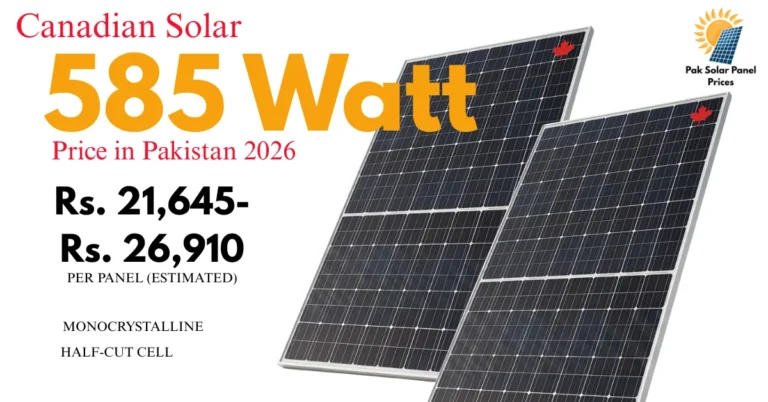
The practical recommendation for most Pakistani homes: A 5kW solar system (8–9 panels of 585W) covers one 1.5 ton inverter AC running 8–10 hours per day, alongside fans, lights, a refrigerator, and a television. This is the sweet spot — enough capacity to handle real-world load, with a small surplus for net metering.
The Step-by-Step Calculation Explained
Here is the exact math behind the panel count so you can verify it or adapt it to your specific usage.
Step 1 Find daily AC energy consumption
A 1.5 ton inverter AC averages 1,300W per hour under typical Pakistani summer conditions.
Step 2 Add your base home load
Typical base load for a 3-bedroom Pakistani home (excluding AC):
| Appliance | Wattage | Hours/Day | Daily kWh |
|---|---|---|---|
| 5 Ceiling Fans | 75W each = 375W | 12 hours | 4.5 kWh |
| 8 LED Lights | 10W each = 80W | 6 hours | 0.5 kWh |
| Refrigerator | 150W average | 24 hours | 3.6 kWh |
| LED TV (43″) | 100W | 5 hours | 0.5 kWh |
| Misc (phone charging, router) | 100W | 8 hours | 0.8 kWh |
| Total Base Load | ~10 kWh/day |
AC load (8 hrs) + base load = 10.4 + 10 = ~20.4 kWh/day total
Step 3 Account for system losses
Step 4 Calculate daily output per panel
Step 5 Divide total need by per-panel output
Read More: AGS Battery Price in Pakistan 2026 – Latest Price List, Models & Buying Guide
Panel Count by Panel Wattage
Pakistan’s market now stocks a range of solar panel wattages. Here is how the panel count changes based on which wattage you choose for a 1.5 ton AC + standard home load system:
| Panel Wattage | Panels Needed (AC + Full Home Load) | Total System Size |
|---|---|---|
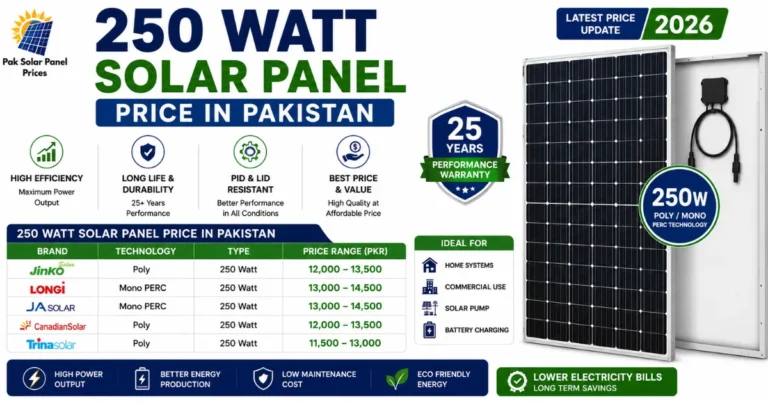
| 400W | 12 – 14 panels | 4.8kW – 5.6kW |
| 440W | 11 – 13 panels | 4.8kW – 5.7kW |
| 540W | 9 – 10 panels | 4.9kW – 5.4kW |
| 585W | 8 – 9 panels | 4.7kW – 5.3kW |
| 630W | 7 – 8 panels | 4.4kW – 5.0kW |
Higher wattage panels cost slightly more per panel but fewer are needed. For roofs with limited space, 585W or 630W panels are the practical choice.
What System Do You Need? (3 Scenarios)
Scenario 1 AC Only During Daytime, No Backup Needed
Situation: You have stable WAPDA supply in the evening, only want to offset daytime AC cost.
Best for: Karachi, areas with 2–4 hours load shedding maximum
Scenario 2 AC Plus Home Load, With Load Shedding Backup
Situation: You face regular load shedding and want the AC and other appliances to keep running.
Best for: Lahore, Islamabad, Faisalabad, Multan, and most of Punjab where 6–10 hours load shedding is common
Scenario 3 Complete Energy Independence (Day + Night AC)
Situation: You want to run the AC even at night without relying on WAPDA at all.
Best for: Rural areas with extreme load shedding, buyers who want maximum energy independence
Complete System Cost for Running a 1.5 Ton AC on Solar
Option A Basic System (AC Daytime Only, No Battery)
| Component | Specification | Estimated Cost |
|---|---|---|
| Solar Panels | 6 × 585W = 3.5kW (Longi/Jinko) | PKR 95,000 – 1,20,000 |
| On-Grid / Hybrid Inverter | 3.5kW (Solis / Knox) | PKR 90,000 – 1,30,000 |
| Mounting Structure | 6 panels | PKR 18,000 – 36,000 |
| DC + AC Wiring & Breakers | Standard run | PKR 12,000 – 20,000 |
| Installation Labor | PKR 10,000 – 20,000 | |
| Total | PKR 2,25,000 – 3,26,000 |
Option B Standard System (AC + Home Load + Battery Backup)
| Component | Specification | Estimated Cost |
|---|---|---|
| Solar Panels | 9 × 585W = 5.2kW (Longi/Jinko) | PKR 1,40,000 – 1,80,000 |
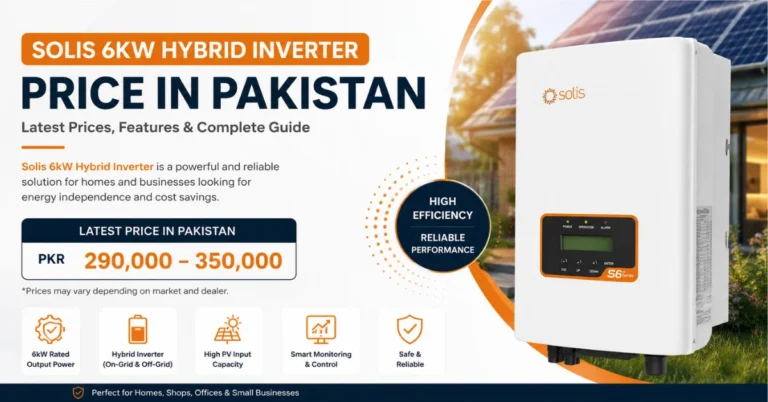
| Hybrid Inverter | 5kW – 6kW (Knox / Growatt / Inverex) | PKR 1,67,000 – 2,95,000 |
| Lithium Battery | 2 × 100Ah (Pylontech / Dyness) | PKR 1,70,000 – 2,20,000 |
| Mounting Structure | 9 panels | PKR 27,000 – 54,000 |
| DC + AC Wiring & Breakers | PKR 15,000 – 25,000 | |
| Installation Labor | PKR 15,000 – 30,000 | |
| Total | PKR 5,34,000 – 8,04,000 |
Option C Premium System (Overnight AC Operation, Full Independence)
| Component | Specification | Estimated Cost |
|---|---|---|
| Solar Panels | 16 × 585W = 9.4kW (Tier-1) | PKR 2,50,000 – 3,20,000 |
| Hybrid Inverter | 10kW (Huawei / GoodWe / Growatt) | PKR 3,80,000 – 5,50,000 |
| Lithium Battery Bank | 4 × 100Ah LiFePO₄ | PKR 3,40,000 – 4,40,000 |
| Mounting Structure | 16 panels | PKR 48,000 – 96,000 |
| DC + AC Wiring & Breakers | PKR 20,000 – 35,000 | |
| Installation Labor | PKR 25,000 – 50,000 | |
| Total | PKR 10,63,000 – 14,91,000 |
Inverter AC vs Non-Inverter AC on Solar Why It Matters So Much
This point deserves its own section because it genuinely changes everything about your solar calculation.
A 1.5 ton non-inverter AC draws roughly 2,000–2,400W continuously whenever the compressor is running. A modern 5-star inverter AC from Gree, Haier, Dawlance, or Kenwood draws an average of 900–1,300W over the same cooling period.
That difference means:
- Non-inverter AC: You need a 6kW+ solar system to run it reliably
- Inverter AC: A 5kW system is enough with capacity to spare for other appliances
Over a year, that extra 1kW of system capacity you would need for a non-inverter AC costs approximately PKR 80,000–1,50,000 more in solar panels and inverter capacity. The price difference between a good non-inverter and a good inverter 1.5 ton AC is typically PKR 20,000–40,000. The solar savings more than justify the switch.
If you are buying a new AC for a solar home, only buy an inverter model. There is no financially sound reason to choose otherwise.
Top Inverter AC Brands Recommended for Solar Use in Pakistan
| Brand | Model Example | Avg. Wattage (1.5 ton) | Star Rating | Price Range |
|---|---|---|---|---|
| Gree | Inverter U-Crown | 1,100W avg | 5-star | PKR 95,000 – 1,20,000 |
| Haier | DC Inverter HSU-18HFC | 1,150W avg | 5-star | PKR 90,000 – 1,15,000 |
| Dawlance | Inverter Harmony Plus | 1,200W avg | 5-star | PKR 85,000 – 1,10,000 |
| Kenwood | e-Inverter Plus | 1,100W avg | 5-star | PKR 88,000 – 1,12,000 |
| Orient | Thor Inverter | 1,200W avg | 5-star | PKR 82,000 – 1,05,000 |
| Samsung | Wind-Free AR18 | 950W avg | 5-star | PKR 1,20,000 – 1,60,000 |
Key spec to check when buying: Look for an AC with a SEER rating above 18 or an energy efficiency label showing 5 stars. The higher the rating, the fewer solar panels you need to run it.
City-Wise Panel Count Adjustment
Pakistan’s sunlight hours vary significantly by region. This directly affects how many panels you need:
| City | Peak Sunlight Hours | Adjustment |
|---|---|---|
| Karachi | 5.5 – 6.5 hrs | Fewer panels needed |
| Multan / Sukkur | 6.0 – 7.0 hrs | Fewest panels needed |
| Quetta | 6.0 – 7.0 hrs | Fewest panels needed |
| Lahore | 4.5 – 5.5 hrs | Standard calculation |
| Islamabad | 4.5 – 5.5 hrs | Standard calculation |
| Peshawar | 5.0 – 6.0 hrs | Slightly fewer panels |
| Bahawalpur | 5.5 – 6.5 hrs | Fewer panels needed |
Example: If you live in Multan and get 6.5 hours of sunlight, your 585W panel produces 3.8 kWh/day instead of 2.9 kWh. This means you might need 7 panels instead of 9 for the same load.
If you live in Lahore or Islamabad with 4.5 hours average during monsoon months (July–September), you may need 1–2 extra panels to compensate for lower winter and monsoon output.
Do You Need a Battery to Run an AC on Solar?
This is one of the most common points of confusion. The short answer: it depends on your situation.
| Situation | Battery Needed? | Why |
|---|---|---|
| AC only during sunny hours (10am–4pm), stable WAPDA at night | No | On-grid system covers daytime; WAPDA covers night |
| Regular load shedding during day or evening | Yes | Battery keeps AC running when grid fails |
| Want AC overnight without WAPDA | Yes (large bank) | Needs 10–15 kWh lithium storage minimum |
| Want maximum bill savings + load shedding backup | Recommended | Hybrid gives best of both worlds |
Important battery note for AC use: A 1.5 ton inverter AC draws about 1,200–1,500W continuously. A single 100Ah lithium battery at 48V holds about 4.8 kWh of usable energy. Running the AC alone, this gives approximately 3–4 hours of backup. For 6–8 hours of overnight cooling, you need 2–3 battery units minimum.
Roof Space Required for Your Solar Panels
Before deciding on panel count, check your available roof space. Each 585W Tier-1 panel measures approximately 2.3m × 1.1m (about 2.5 square meters).
| Panels Needed | Roof Space Required |
|---|---|
| 5 panels (AC only) | ~12.5 square meters |
| 8 panels (AC + home load) | ~20 square meters |
| 10 panels (full system) | ~25 square meters |
| 16 panels (overnight system) | ~40 square meters |
A standard 5-marla house typically has 40–50 square meters of usable roof space. A 10-marla house has 80–100 square meters. Roof obstructions (water tanks, chimneys, satellite dishes) reduce usable area. Ask your installer to assess your roof before finalizing panel count.
Financial Savings Is It Worth It?
Pakistan’s electricity tariff stands at Rs. 45–60 per unit in most DISCO zones in 2026. Running a 1.5 ton inverter AC for 8 hours daily at Rs. 50/unit costs approximately:
A 5kW solar system (Option B above) costs approximately Rs. 5,50,000–8,00,000. It covers not just the AC but your entire home load, saving Rs. 25,000–40,000/month total.
Simple payback calculation:
After payback, you enjoy near-zero electricity costs for the remaining 23+ years of the system’s life.
Common Mistakes to Avoid
Mistake 1 Undersizing the system Many buyers try to run a 1.5 ton AC on a 3kW system to save money. In Pakistan’s heat, the AC runs at high load constantly. A 3kW system managing both AC and home load will trip the inverter or fail to maintain output. Size the system properly from the start.
Mistake 2 Using a non-inverter AC on solar A non-inverter AC has startup surges of 3–4× its running wattage. This can trip a 5kW inverter’s protection circuits. Inverter ACs ramp up gradually and work smoothly with solar inverters. Always use an inverter AC on a solar system.
Mistake 3 Ignoring panel orientation and shading Solar panels produce maximum output when facing south at a tilt angle matching your latitude (25–35 degrees for most of Pakistan). Even partial shading from a water tank or parapet wall reduces output by 15–30%. Poor orientation can reduce your effective panel count by 20%.
Mistake 4 Buying cheap panels to reduce upfront cost A B-grade panel that produces 10% below its rated output means your 9-panel system effectively becomes an 8-panel system without you knowing it. Buy A-grade Tier-1 panels with full documentation and warranty.
Mistake 5 Not planning for monsoon season Lahore and Islamabad receive significantly less sunlight in July–September. A system perfectly sized for May will underperform in August. Add 1–2 extra panels or size for monsoon output, not peak summer output.
Frequently Asked Questions (FAQs)
Q: How many solar panels do I need for a 1.5 ton AC?
For an inverter AC running during daytime only: 5–6 panels of 585W. For the AC plus full home load running 8–10 hours/day: 8–10 panels. For overnight operation including load shedding backup: 14–16 panels with a lithium battery bank.
Q: Can a 3kW solar system run a 1.5 ton AC?
Barely, and only in isolation. A 1.5 ton inverter AC draws 1,200–1,500W at peak cooling. A 3kW system can handle this, but leaves almost no capacity for fans, lights, or a refrigerator. For real-world use alongside other appliances, 5kW is the minimum recommended size.
Q: Can a 5kW solar system run a 1.5 ton AC?
Yes comfortably. A 5kW system running 8–9 panels of 585W generates 20–25 units per day in most Pakistani cities. This covers one 1.5 ton inverter AC running 8 hours daily plus standard home appliances.
Q: Is an inverter AC better than non-inverter AC for solar?
Yes, significantly. An inverter AC uses 30–40% less electricity for the same cooling. This directly reduces the number of solar panels you need. On a solar system, always use an inverter AC.
Q: How many hours can a battery run a 1.5 ton AC?
One 100Ah lithium battery at 48V provides approximately 4.8 kWh of usable energy. A 1.5 ton inverter AC drawing 1,300W will run for 3–4 hours on one battery. For 8 hours of backup, you need 2–3 batteries of 100Ah each.
Q: What is the price of a solar system to run a 1.5 ton AC in Pakistan?
For AC-only daytime use: PKR 2,25,000 – 3,26,000 (no battery). For AC plus full home load with battery backup: PKR 5,34,000 – 8,04,000. For overnight AC operation: PKR 10,63,000 – 14,91,000.
Q: Which direction should panels face for maximum output?
South-facing panels at a tilt of 25–35 degrees produce maximum annual output in Pakistan. East-facing panels generate more in the morning; west-facing in the afternoon. Avoid north-facing installation it loses 30–40% of potential output.
Q: Do I need net metering to save money on AC running costs?
Net metering is not mandatory for savings. Any solar system reduces your bill by offsetting daytime consumption. Net metering adds to savings by crediting excess electricity exported to the grid. It is worth registering if your system regularly generates more than you consume.
Making the Right Decision
Running a 1.5 ton AC on solar is not just possible in Pakistan it has become the practical, financially rational choice for any household paying Rs. 10,000 or more per month in electricity bills.
The exact number of panels you need ranges from 5 to 16 depending on your specific situation. For most Pakistani families one 1.5 ton inverter AC, standard home appliances, and 6–8 hours daily usage 8 to 9 panels of 585W paired with a 5kW hybrid inverter and 2 lithium batteries covers everything reliably, handles daily load shedding, and pays back within 2–3 years.
Before you buy, get at least two itemized quotes from reputable installers. Ask them to calculate your system size based on your actual electricity bill and usage pattern not a generic estimate. A properly sized system is the difference between an investment that pays you back for 25 years and an undersized system that disappoints from day one.
 Join Channel