

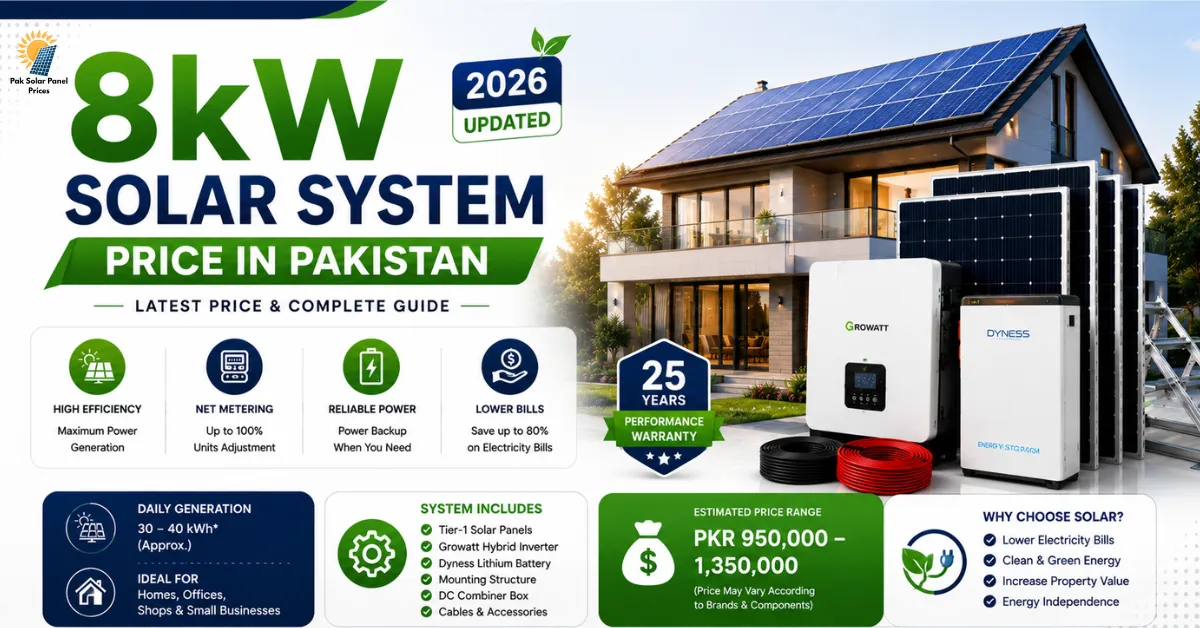
8kW Solar System Price in Pakistan 2026 – Is It the Best Option for Large Homes?
Since the cost of electricity is constantly rising, a lot of people in Pakistan are now switching to 8kW solar systems from 5kW systems because of more energy freedom. 8kW solar systems are for people who consume more electricity, have a number of air conditioners, and have large houses.
Rather than asking “What is the cost of an 8kW solar system?” a person should ask “Would an 8kW system suit my needs?” This article gives the answer to both questions.
Read More: 10kW Solar System Price in Pakistan 2026 – Latest Price List
At a Glance
| Specification | Details |
|---|---|
| Recommended Monthly Usage | 800–1,100 Units |
| Daily Electricity Generation | 30–38 Units |
| Solar Panels Required | 13–14 Panels (590W–620W) |
| Roof Space Required | 520–650 sq. ft. |
| Ideal For | Large Homes, Villas & Offices |
| Average System Life | 25+ Years |
Latest 8kW Solar System Price in Pakistan
| Package | Estimated Price (PKR) |
|---|---|
| On-Grid 8kW System | Rs. 820,000 – 980,000 |
| Hybrid 8kW System | Rs. 980,000 – 1,180,000 |
| Hybrid + 10kWh Lithium Battery | Rs. 1,250,000 – 1,550,000 |
| Off-Grid 8kW System | Rs. 1,150,000 – 1,450,000 |
Prices depend on panel brand, inverter quality, battery capacity, installation charges, and market conditions.
Can an 8kW Solar System Run Your Entire Home?
For many households, the answer is yes.
An 8kW system can comfortably power:
- 3–4 Inverter Air Conditioners
- Refrigerator
- Deep Freezer
- Water Pump
- Washing Machine
- Microwave Oven
- LED TV
- Desktop Computers
- Laptops
- Wi-Fi Router
- Ceiling Fans
- LED Lighting
- Kitchen Appliances
The exact load depends on how many appliances are used simultaneously.
Where Does Your Money Go?
Many buyers think they are paying only for solar panels, but the total project cost includes much more.
| Component | Share of Total Cost |
|---|---|
| Solar Panels | 42–48% |
| Hybrid/On-Grid Inverter | 18–25% |
| Mounting Structure | 8–10% |
| Electrical Protection | 5–7% |
| Wiring & Accessories | 4–6% |
| Installation & Testing | 8–10% |
| Documentation & Miscellaneous | Remaining Cost |
Understanding this breakdown helps you compare quotations from different installers.
Is an 8kW System Better Than a 5kW System?
| Feature | 5kW | 8kW |
|---|---|---|
| Daily Production | 20–25 Units | 30–38 Units |
| Monthly Bill Coverage | Medium | High |
| Air Conditioner Support | 1–2 ACs | 3–4 ACs |
| Best For | Small Families | Large Families |
If your electricity consumption regularly exceeds 800 units per month, upgrading directly to 8kW is often more practical than expanding a smaller system later.
How Long Will It Take to Recover the Investment?
Most homeowners recover the cost of an 8kW solar system within 3 to 5 years, depending on:
- Electricity tariff
- Daily energy usage
- Net metering income
- System efficiency
- Maintenance
After the payback period, the electricity generated by the system is essentially free apart from routine maintenance.
Choosing the Right Equipment
A high-quality solar system is not just about premium panels.
For the best long-term performance, select:
- Tier-1 N-Type Solar Panels
- Hybrid Inverter with Wi-Fi Monitoring
- Hot-Dip Galvanized Mounting Structure
- DC & AC Surge Protection
- Genuine MC4 Connectors
- Certified Installation Team
Investing in reliable equipment reduces maintenance costs and improves system lifespan.
Who Should Consider an 8kW Solar System?
An 8kW installation is ideal for:
- Double-storey houses
- Luxury homes
- Farmhouses
- Clinics
- Schools
- Small businesses
- Commercial offices
- Homes planning future electric vehicle charging
Latest Post
- itel Lithium Battery 24V Price in Pakistan 2026 – Latest Price, Specifications & Buying Guide
- Install Solar Panels Cost in Pakistan 2026 – Complete Guide
- Solar Geyser Price in Pakistan
- Millat Battery Price in Pakistan 2026
- Solar Geyser Price in Pakistan 2026 – Latest Rates, Types & Buying Guide
Conclusion
Not only is an 8kW solar power system a means of reducing your electricity costs, but it is also an investment for ensuring your energy security for years to come. The capacity of such a system not only to produce plenty of electricity, but also to run multiple appliances and work effectively in combination with the net metering system makes it a great choice for large households.
 Join Channel