

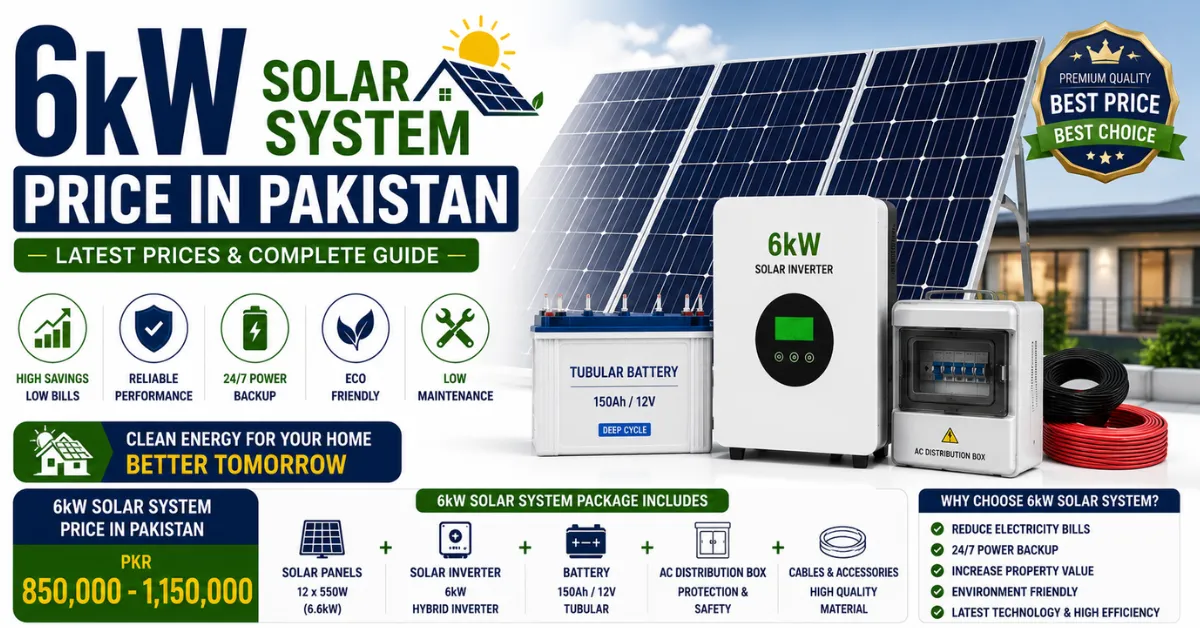
6kW Solar System Price in Pakistan – Updated Price List 2026
Ask around and you’ll notice something: the 6kW solar system comes up more often than any other size when Pakistani homeowners talk about going solar. It’s not a coincidence it happens to be the size that fits a typical family home running two ACs, a fridge, a washing machine, and everyday appliances, without forcing you into commercial-scale pricing. Here’s what it actually costs, what’s included, and whether it’s the right fit for your house.
6kW Solar System Price Range
|
System Type |
Price Range (PKR) |
Load-Shedding Backup |
|---|---|---|
|
On-grid (no battery) |
450,000 – 850,000 |
No |
|
Hybrid, no battery |
700,000 – 900,000 |
No (battery-ready) |
|
Hybrid + lead-acid/tubular battery |
850,000 – 1,000,000 |
Yes |
|
Hybrid + lithium battery |
950,000 – 1,400,000+ |
Yes (longer-lasting) |
The gap between the low and high end mostly comes down to panel grade, inverter brand, and whether you’re adding storage. A basic on-grid setup built around budget components sits at the bottom of that range; a fully-loaded hybrid system with a premium inverter and lithium battery sits at the top.
Read More: 10kW Solar System Price in Pakistan 2026 – Latest Price List
Is 6kW the Right Size for Your Home?
A 6kW system is generally a good match if:
If your bill regularly crosses PKR 50,000 or you’re running three or more ACs, it’s worth getting a quote for 8–10kW instead a 6kW system will still help, but you’ll end up drawing more from the grid than you’d like during peak hours.
What’s Included in the Package
A typical 6kW installation includes:
If net metering is part of your plan, budget separately for the bi-directional meter and DISCO application this is sometimes quoted apart from the system price, so always ask upfront whether it’s bundled in.
How Much Power Does It Generate?
|
Metric |
Estimate |
|---|---|
|
Daily generation |
22–35 units (kWh) |
|
Monthly generation |
650–900 units |
|
Annual generation |
Roughly 5,400–8,400 kWh |
Output on the higher end is more common in sunnier regions like Multan, Sukkur, and Quetta, while cities like Lahore and Islamabad tend to sit closer to the lower end during monsoon months. Shading from trees, water tanks, or neighboring buildings can pull output down further, so a clear, unshaded roof matters more than people usually expect.
Read More: 20kW Solar System Price in Pakistan 2026 – Latest Price Guide
What Can You Run on a 6kW System?
With proper load management, a 6kW system can typically handle, at the same time during daylight hours:
Payback Period 6kW Solar System
Most homeowners recover the cost of a 6kW Solar System within 4 to 6 years, depending on whether they went on-grid or hybrid, and how much of the daytime generation they actually consume rather than export. Households with steady daytime usage someone home during the day, or appliances running on timers tend to see faster payback because more of the generated power offsets consumption directly instead of being exported at the lower net billing rate.
A Quick Note on Net Billing (2026 Update)
If you’ve been comparing quotes against older articles, keep in mind that Pakistan moved away from the old one-for-one net metering model in 2026. Exported units are now bought back at a separate, generally lower rate under NEPRA’s net billing framework, while grid electricity you consume is still billed at full retail price. This makes it more valuable to size your system around your actual daytime load rather than assuming every extra unit exported will fully offset your bill. If you already had an agreement signed before the change, your existing terms remain protected until it expires.
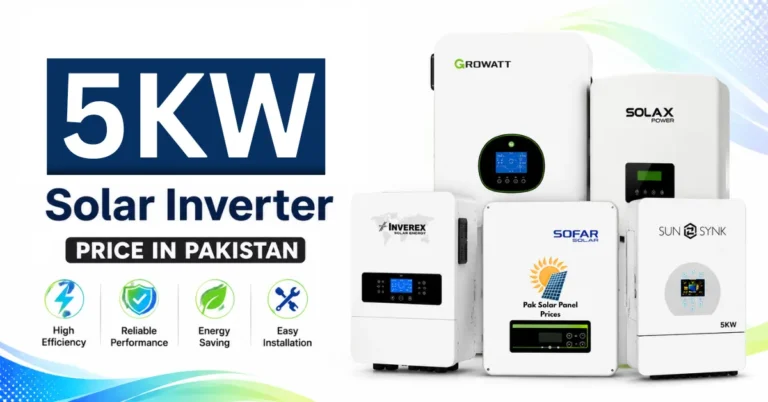
Popular Inverter Brands for 6kW Systems
|
Brand |
Price Range (PKR) |
Known For |
|---|---|---|
|
Inverex Nitrox |
140,000 – 200,000 |
Strong local warranty, dual AC output |
|
Growatt |
150,000 – 220,000 |
Reliable mid-range hybrid performance |
|
Knox Krypton |
200,000 – 270,000 |
Higher-capacity hybrid models |
|
Huawei SUN2000 |
250,000+ |
Premium build, advanced monitoring |
When comparing inverters, two features matter more than the price tag: dual AC output (so heavy appliances shut off automatically during an outage to save battery life) and compatibility with lithium batteries via a proper Battery Management System port.
Latest Post
- itel Lithium Battery 24V Price in Pakistan 2026 – Latest Price, Specifications & Buying Guide
- Install Solar Panels Cost in Pakistan 2026 – Complete Guide
- Solar Geyser Price in Pakistan
- Millat Battery Price in Pakistan 2026
- Solar Geyser Price in Pakistan 2026 – Latest Rates, Types & Buying Guide
Conclusion
A 6kW Solar System sits right in the sweet spot for most Pakistani households that have outgrown a 3–5kW setup but don’t need commercial-scale capacity. Budget PKR 700,000–900,000 for a solid hybrid system without battery, and adjust upward for storage or premium brands. As always, insist on an itemized quote panel count, exact wattage, inverter model, and whether net metering paperwork is included rather than a single bundled number.
 Join Channel