

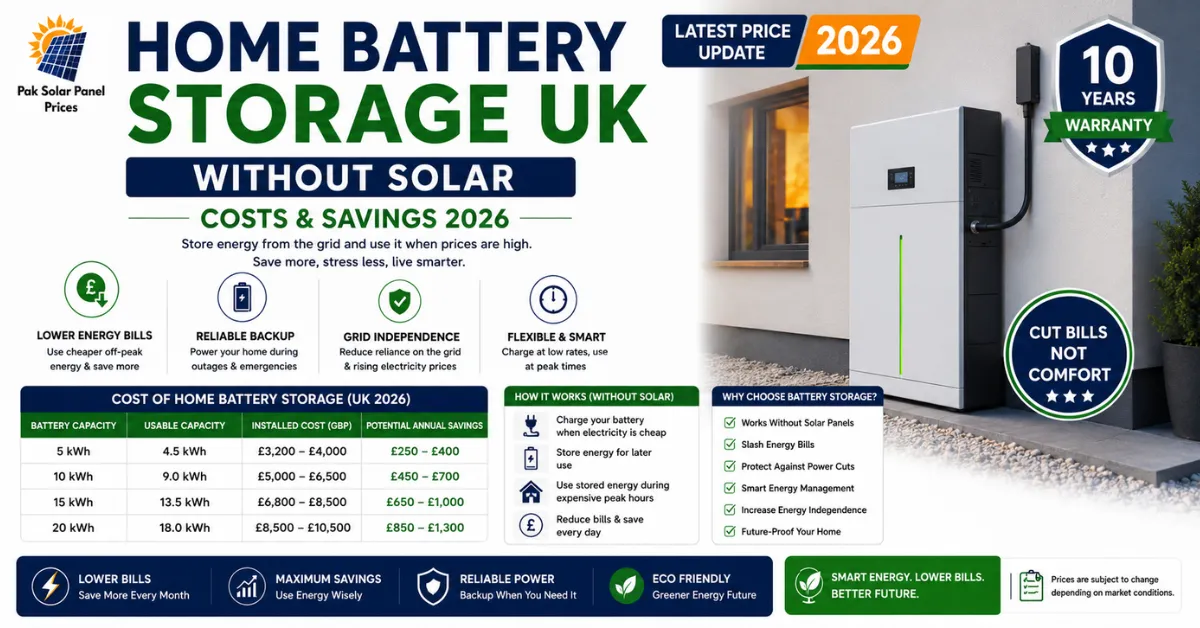
Home Battery Storage in the UK Without Solar – Is It Worth It in 2026?
Most people assume a home battery only makes sense bolted onto solar panels. That’s not true and for the roughly one in three UK homes with a roof unsuited to solar (flat, north-facing, shaded, or structurally weak), a standalone battery might be the only realistic way to cut electricity costs beyond just switching supplier. Home Battery Storage UK Without Solar what actually happens when you install one without any panels attached.
How a Battery-Only System Works
Without solar, a home battery doesn’t generate anything it simply moves electricity through time. It charges from the National Grid during cheap overnight hours under a time-of-use tariff, then discharges to power your home during expensive peak periods later in the day. This is usually called load shifting or price arbitrage, and it’s the entire financial case for a standalone battery.
Read More: 500 Watt Solar Plate Price in Pakistan 2026 – Today Updated Price List
The system connects directly to your consumer unit and the grid, and (if you want backup during power cuts) a separate Emergency Power Supply circuit needs to be wired in by your installer. Approval for the installation depends on your inverter’s rated output rather than the battery’s storage capacity anything above a certain threshold requires sign-off from your Distribution Network Operator before commissioning.
What It Actually Costs Home Battery Storage UK Without Solar
Standalone battery installations in the UK typically run £3,000 to £8,000, with a mid-range 8–10kWh system landing around £5,000–£7,750 depending on brand, capacity, and installation complexity. Since February 2024, standalone battery storage has qualified for 0% VAT in the UK a rule scheduled to hold until July 2027, after which it’s expected to rise to 5% rather than snap back to the full 20%. That timing alone is worth factoring into a “buy now vs. wait” decision.
Well-known battery options in this space include Tesla Powerwall 3, GivEnergy’s all-in-one hybrid units, Sigenergy’s SigenStor, and Fox ESS pricing and warranty terms vary enough between them that getting more than one quote is worth the effort rather than defaulting to the most heavily advertised name.
The Tariff Actually Decides Your Payback Time
This is the part most buyers underestimate the battery itself is almost a commodity the tariff you pair it with determines whether the investment makes sense at all.
| Tariff Type | Off-Peak Window | Typical Payback (8–16kWh battery) |
|---|---|---|
| Economy 7 / Octopus Go | ~7 hours overnight | Roughly 3.2–3.4 years |
| Good Energy Heat Pump tariff | Split windows (early morning + afternoon) | Varies by usage, often under 5 years for high-consumption homes |
| Agile Octopus | Dynamic, hourly pricing | Roughly 7 years spread between cheap/expensive hours is narrower on average |
A flat, predictable tariff with a wide gap between off–peak and peak rates will consistently outperform a dynamic tariff for battery-only households, simply because the daily arbitrage margin is more reliable. Ironically, the tariffs marketed as “smart” and dynamic often deliver a slower payback for a battery-only setup than a simple fixed off-peak plan.
Read More: Maryam Nawaz Solar Panel Scheme 2026 Registration & Latest Updates
A Worked Example
Take a household using the UK average of around 3,400kWh a year, paired with a 10kWh battery on a tariff offering roughly 14p/kWh during off-peak windows versus 30p+/kWh at peak. Filling the battery overnight and discharging it during the following day’s peak hours can offset a meaningful chunk of daily consumption real-world estimates from current tariff data put annual savings for a household at this usage level somewhere around £350–£400 a year on the right plan, climbing well beyond that for higher-usage homes running an EV charger or heat pump on the same setup.
Over a battery’s typical 6,000-cycle lifespan (roughly 15–16 years), that compounds into a net benefit in the £5,000–£7,700 range once the upfront cost is paid off though this only holds if the tariff and charging schedule are actually maintained over time, not set once and forgotten.
Grants and Extra Incentives
Standalone batteries generally don’t qualify for dedicated “free battery” grants the way full solar-and-battery packages sometimes do, but a few routes can still reduce the bill:
Where a Battery-Only System Falls Short
It’s not a universal win. A few honest limitations worth weighing before committing:
Read More: Jinko Tiger Neo 585W Solar Panel Price in Pakistan 2026 | Latest Market Rates
Who Should Actually Consider This
A standalone battery makes the most financial sense for households that: use more than roughly 4,000kWh a year, already run or plan to add a heat pump or EV charger, have access to a strong time-of-use tariff with a wide peak/off-peak spread, and are comfortable letting a smart tariff run in the background rather than managing it manually.
For everyone else particularly lower-usage households without flexible tariff access the payback math gets considerably less compelling, and it’s worth running your own numbers against your actual annual kWh usage before committing several thousand pounds upfront.
Final Thoughts
A Home Battery Storage UK Without Solar isn’t about generating free power it’s a bet that the gap between cheap overnight electricity and expensive peak-time electricity will keep paying for itself, tariff by tariff, night after night. With 0% VAT still in place and payback periods now sitting around 3–4 years on the right off-peak tariff, the case has genuinely improved over the past couple of years but only for households with the usage patterns and tariff discipline to make the arbitrage actually work.


 Join Channel