

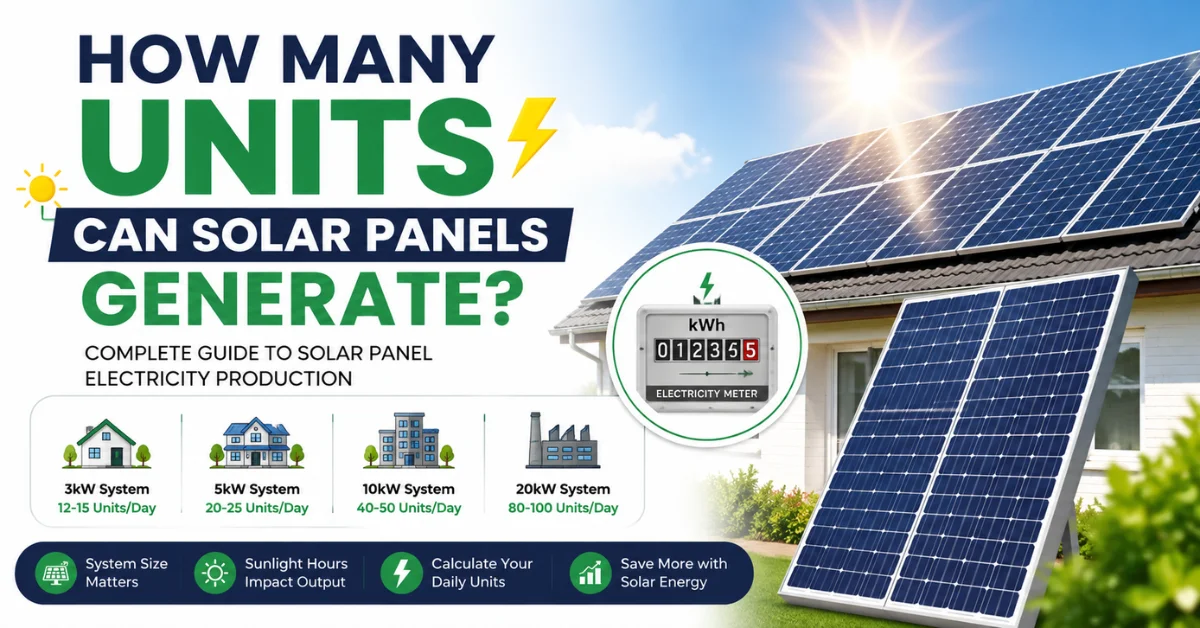
How Many Units Can Solar Panels Generate? Daily & Monthly Output
The number one question that comes up for consideration when people want to install solar energy systems is how many units can solar panels generate? This depends on the capacity of the panels, number of panels, sun exposure, weather, temperature, shade, dirt, and system efficiency.
Solar energy production can be significantly high in Pakistan due to the availability of strong sun rays most of the year round in many places. But solar energy is not consistent everyday. It may be higher in sunny days in summer and lower on cloudy days or in winter season.
For residential consumers, knowing the solar energy production in units (kWh) is helpful since the electricity bill in Pakistan is in units consumed.
What is One Unit of Solar Electricity?
In electricity billing, 1 unit is equal to 1 kilowatt-hour (kWh). This means that if a solar system supplies 1 kilowatt of power for one hour, it produces approximately 1 kWh, or one unit, under ideal conditions.
For example:
- 1 kWh = 1 unit
- 10 kWh = 10 units
- 100 kWh = 100 units
- 500 kWh = 500 units
Read More: How to Calculate Solar Panel Requirements in Pakistan? Complete Guide
Solar Panel Capacity vs Electricity Generation
The capacity of a solar panel is not a unit of energy that the solar panel generates daily.
For example, when a solar panel is labeled as 580W, it does not imply that it will produce 580 watts of power throughout the day.
The performance of the solar panel varies according to varying sunlight intensity. During good sunlight intensity, the solar panel generates nearly all of its rated power. However, during poor sunlight, the solar panel might generate low power.
How Many Units Does One Solar Panels Generate?
Production from one solar panel per day will depend on how many watts the panel has and the availability of sunshine. One can produce some units of power in a day depending on the conditions. Production will vary depending on when the panel is placed in.
These include;
- On a clear sunny summer day
- On a cloudy winter day
- On a dusty day
- On a partly shaded roof
- On a very hot afternoon
Read More: Solar Panel Output in Summer vs Winter in Pakistan – Complete Guide
Approximate Daily Production by Panel Size
A useful way to understand solar production is to look at approximate ranges rather than a single fixed number.
| Panel Size | Approx. Daily Generation* |
|---|---|
| 450W | Around 1.5–2.5 units |
| 500W | Around 1.8–2.8 units |
| 550W | Around 2.0–3.2 units |
| 580W | Around 2.1–3.4 units |
| 585W | Around 2.1–3.5 units |
| 600W | Around 2.2–3.6 units |
What Determines the Number of Units Generated?
There are various factors that impact the production of electricity from solar.
Solar Irradiance
- The amount of sunlight falling on the panel is one of the main factors. Clear weather conditions will produce higher solar irradiance, while cloud cover will decrease the amount of sunlight hitting the cells.
Panel Orientation
- Panels must be oriented properly for receiving the maximum amount of sunlight. Improper orientation can lower the generation even if the panels are of high quality.
Tilt Angle
- Angle at which the panels are fixed also impacts the amount of sunlight received by the modules in a year. Optimal configuration depends on geographical location and system configuration.
Shading
- Even partial shading may affect the solar generation, especially in case of string of several panels. Trees, buildings, walls, water tank and other structures around should therefore be considered before installing panels.
Temperature
- Solar panels usually get less powerful with increase in cell temperature. This is specifically true about the hot summer months in Pakistan. While sunlight may boost the production, the increased temperature of the panel can reduce the electrical generation of modules.
Dust and Dirt
- Dust deposition reduces the amount of sunlight reaching the solar cells. Pakistan’s dusty environment means regular inspection and appropriate cleaning can help maintain production.
Inverter Efficiency
- The inverter converts DC electricity from the solar panels into usable AC electricity. Some energy is lost during this conversion.
Why Does Solar Generation Change Every Month?
The production of solar energy is seasonal. In certain months, there may be good weather for production whereas in others, the weather may not favor solar generation.
The temperature too varies during the year. Therefore, there can be a variation in solar power generation in the month of January, April, July and December. Solar energy generation should be compared on an annual basis and not on a monthly basis.
Read More: How to Check Solar Panel Serial Number? Complete Guide for Buyers
Do Solar Panels Generate the Same Units Every Day?
No. Production from solar panels varies daily. A bright day may produce much more power than a cloudy day. Other factors that might affect production include:
- Rain
- Dust
- Haze
- High temperature
- Shading
- Panel angle
- Grid/inverter limitations
How Can You Increase Solar Unit Generation?
Sunlight availability is out of your control, but you can minimize losses wherever possible. Some ways of doing this are:
- Keep panels relatively clean
- Minimize shading where possible
- Optimize panel positioning
- Maintain suitable panel spacing
- Ensure proper wiring
- Use an appropriately sized inverter
- Performance monitoring
- Defective module detection
- Maintain the mounting structure
Conclusion
But then, How Many Units Can Solar Panels Generate? The answer to this question varies based on the wattage of the panels, amount of sunlight available, heat, weather conditions, shading, dust, positioning of the panels, inverter efficiency and overall system design.
A single high-powered panel may produce several units on a favorable day, while an entire 5kW or 10kW system may produce several hundreds of units in a month depending on their geographical and seasonal positions.

 Join Channel