

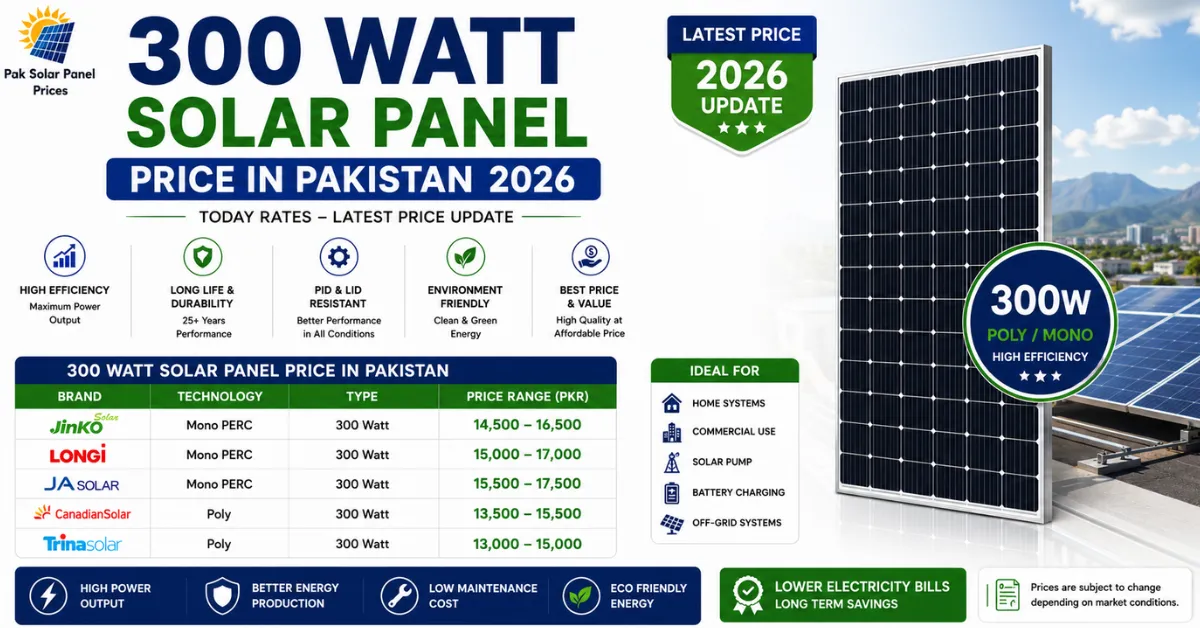
300 Watt Solar Panel Price in Pakistan 2026 – Today Updated Price List
The 300 watt solar panel is a great option for individuals who require a small and economic solar system for residential, commercial, farming, security purposes, or off-grid use. While more powerful solar panels such as 550W to 700W N-type solar panels currently rule the market, 300 watt solar panels can be found being used in small-scale backup systems, battery charging, or portable solar devices. However, their usage is decreasing in Pakistan as well.
Read More: 350 Watt Solar Panel Price in Pakistan 2026 | Latest Today Price List
Latest 300 Watt Solar Panel Price in Pakistan (2026)
| Panel Type | Estimated Price (PKR) |
|---|---|
| 300W Polycrystalline Solar Panel | Rs. 12,000 – 16,000 |
| 300W Monocrystalline Solar Panel | Rs. 15,000 – 20,000 |
| 300W A-Grade Imported Panel | Rs. 18,000 – 22,000 |
| 300W Local Solar Panel | Rs. 10,000 – 14,000 |
Why Are 300W Solar Panels Still Popular?
Although larger panels provide better efficiency, 300W panels remain useful for smaller applications where roof space and electricity demand are limited.
Common uses include:
- Small home solar systems
- Battery charging
- UPS backup
- CCTV systems
- Water pumps
- Street lights
- Farmhouses
- Shops
- Mobile solar units
- RVs and caravans
Technical Specifications
| Specification | Details |
|---|---|
| Rated Power | 300 Watts |
| Panel Type | Mono or Polycrystalline |
| Voltage | 24V–36V |
| Efficiency | 17%–20% |
| Weight | 17–20 kg |
| Frame Material | Anodized Aluminum |
| Expected Lifespan | 25 Years |
How Much Electricity Can a 300W Panel Generate?
Electricity production depends on sunlight hours and weather conditions.
| Time Period | Estimated Output |
|---|---|
| Per Day | 1.2–1.6 Units |
| Per Month | 36–48 Units |
| Per Year | 430–580 Units |
What Can a 300W Solar Panel Run?
A single 300W solar panel can power small electrical loads such as:
- 4–6 LED Bulbs
- Ceiling Fan
- Wi-Fi Router
- LED Television
- Laptop
- Mobile Charging
- CCTV Cameras
- Small DC Water Pump
For heavier appliances like refrigerators or air conditioners, multiple panels and a suitable inverter are required.
Read More: 500 Watt Solar Plate Price in Pakistan 2026 – Today Updated Price List
Advantages of 300W Solar Panels
Compared with larger commercial panels, a 300W panel offers several practical benefits:
- Affordable initial cost
- Easy transportation
- Simple installation
- Suitable for small rooftops
- Good option for off-grid systems
- Low maintenance
- Long service life
- Compatible with batteries and charge controllers
Factors That Affect the Price
Several factors influence the market price of a 300W solar panel:
- Panel technology (Mono or Poly)
- Brand reputation
- A-Grade or B-Grade quality
- Import costs
- Warranty period
- Market demand
- Dealer pricing
- Exchange rate
Is It Better to Buy a 300W or 600W Solar Panel?
| Feature | 300W Panel | 600W Panel |
|---|---|---|
| Initial Cost | Lower | Higher |
| Efficiency | Moderate | Higher |
| Roof Space | More Required | Less Required |
| Best For | Small Systems | Residential & Commercial Systems |
| Availability | Limited | Widely Available |
Buying Tips
Before purchasing a 300W solar panel:
- Choose A-Grade panels whenever possible.
- Verify the manufacturer warranty.
- Check the panel’s production date.
- Inspect the frame and glass for damage.
- Buy from an authorized dealer.
- Compare prices from multiple suppliers.
- Ensure compatibility with your inverter and charge controller.
Read More: 250 Watt Solar Panel Price in Pakistan 2026 – Today Updated Rates
Conclusion
A 300 Watt Solar Panel is still a good choice for those people who require a compact and affordable solar system. This panel can be used for charging batteries, houses, farms, and even portable solar systems. Yet, in case you are going to install a whole solar system, the current 585W – 620W solar panels would give you better performance.


 Join Channel