
N-Type vs P-Type Solar Panels Which One Is Better?
Solar panels have evolved significantly over the last few years. The discussion that arises frequently during the selection process of current solar modules is N-Type vs P-Type solar panels. Both technologies involve the use of silicon photovoltaic cells to generate electrical power from the sun’s energy.
However, they differ significantly in structure and performance. P-Type solar panels have dominated the market of solar energy for many years while N-Type technology has gained popularity recently. The HJT panels and TOPCon panels are some of the panels using N-Type silicon technology.
What Are N-Type Solar Panels?
In N-Type solar panels, N-Type silicon wafer is used as the material for manufacturing solar cells.
“N-Type” means the formation of certain electrical properties when certain dopants are added to silicon. This type of cells is different in design from conventional P-Type cells and may bring some benefits when designing modern solar modules.
The following types of panels often employ N-Type technology:
- N-Type TOPCon
- HJT
- Some advanced IBC designs
Read More: Crown Solar Inverter Price in Pakistan 2026 – Latest Price List and Models
What Are P-Type Solar Panels?
P-Type solar panels have P-type silicon wafers as their basic material.
The P-Type technology was widely used in the manufacturing of traditional crystalline silicon solar panels and proved to be especially popular for PERC solar panels. It is still possible to produce reliable electricity using P-Type panels, although their initial cost may be crucial when making a choice.
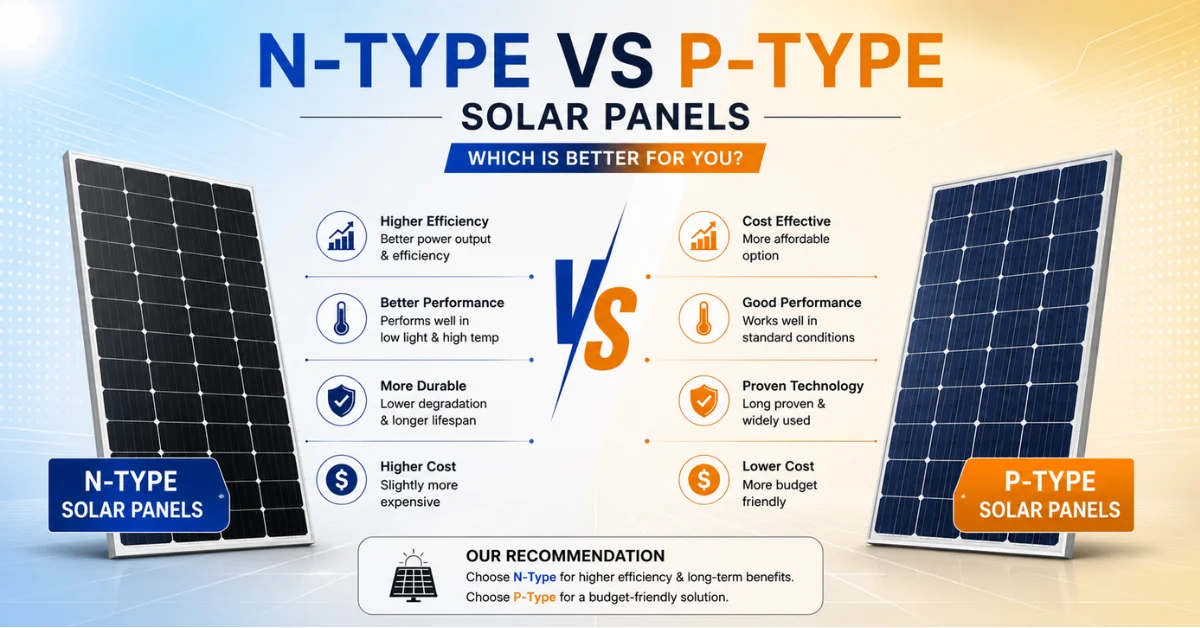
N-Type vs P-Type main Difference
The basic difference is the type of silicon wafer used in the solar cell.
| Feature | N-Type Solar Panels | P-Type Solar Panels |
|---|---|---|
| Silicon wafer | N-Type | P-Type |
| Common technologies | TOPCon, HJT, IBC | PERC and conventional designs |
| Efficiency potential | Generally higher | Generally lower in newer products |
| Degradation | Usually lower | Usually higher |
| Temperature performance | Often better | Varies by product |
| LID resistance | Strong | More susceptible in traditional designs |
| Modern market trend | Growing rapidly | Declining in many markets |
| Initial price | Often higher | Often more affordable |
| Long-term performance | Excellent | Good, depending on model |
Why Is N-Type Technology Becoming Popular?
The most significant factor is the shift towards increased efficiency in the industry.
As manufacturers of solar panels race to create more energy per square foot of roof space, the technologies which have the ability to do so have gained popularity. N-Type technologies are also capable of decreasing degradation factors linked to conventional P-Type silicon.
Read More: Daewoo Battery Price in Pakistan 2026 – Models, Rates, Performance & Buying Guide
N-Type TOPCon vs P-Type PERC
It is one of the most topical comparisons in the current solar market.
- PERC became one of the dominant technologies for P-Type solar panels because it improved the efficiency of conventional crystalline silicon cells.
- TOPCon, on the other hand, is a newer technology commonly built on N-Type silicon.
| Technology | Base Cell Type | General Position |
|---|---|---|
| PERC | Usually P-Type | Mature and widely used |
| TOPCon | N-Type | Modern high-efficiency technology |
| HJT | N-Type | Advanced high-efficiency technology |
Which is Better in Terms of Lifespan, N-Type vs P-Type Solar Panels?
Either type can last for many years if it is made and installed correctly.
However, N-Type solar panels usually have the upper hand compared to P-Type solar panels when it comes to the longevity aspect, owing to their lesser degradation features. With a lower degradation level, the panel will be able to maintain a higher level of its original capacity to generate electricity. This does not necessarily mean that every N-Type panel has a longer life span compared to every P-Type panel.
Are P-Type Solar Panels Still Worth Buying?
Absolutely, provided that the conditions are favorable. P-type panels do not mean necessarily poor quality and non-dependable. Good quality P-type panels will generate energy for a long time. It makes sense to buy such panels when:
- The purchase budget is limited
- Not much roof space is needed
- There is a reliable product available at a fair price
- Performance warranty is appropriate
- The installer has good experience working with the product
N-Type vs P-Type Price Difference
It is dependent on the brand, wattage, efficiency, technology, and market dynamics. Initially, the n-type panels had higher prices since the technology used was relatively new, and there was low capacity in production. With increased production, the price difference has reduced in most markets. In Pakistan, other factors that affect the price include:
- Exchange rates
- Cost of imports
- Brand
- Importer
- Panel wattage
- Stock availability
- Warranty
- Market demand
Read More: How to Check Solar Panel Serial Number? Complete Guide for Buyers
N-Type vs P-Type for Residential Solar in Pakistan
If cost differences are reasonable, the N-Type solar system would be recommended for new residential installations in Pakistan. The advantages include:
- High efficiency
- Minimal degradation
- Excellent power generation
- Optimal use of space on the roof
- Advanced cells
How to Choose Between N-Type vs P-Type?
Don’t base your decision only on the name of the technology but rather on the specific product parameters.
Consider:
- Efficiency: Better efficiency might be advantageous if you have restricted space on your roof.
- Degradation: Lower degradation means better energy generation over time.
- Temperature coefficient: More critical if you live in a hot climate.
- Warranty: Make sure to check the warranty period for both the product and the performance guarantee.
- Rated power: Compare the wattage of the specific modules.
- Dimensions: It’s not always better to go for a panel with a higher wattage if it takes up more space.
- Cost per watt: Good metric to use in order to compare prices.
- Manufacturer support: Warranty and after-sales service matter for a long-term installation.
Conclusion
The major distinguishing factor between N-Type vs P-Type solar cells is the type of silicon wafer utilized in the photovoltaic cell. The use of P-Type technology is very widespread; it has been around for many years and is still able to deliver good-quality solar energy production. The popularity of N-Type has risen as modern N-Type cells have the potential of delivering higher efficiency and performance in terms of high temperature resistance.
In the case of a homeowner in Pakistan considering the installation of a new solar cell system, N-Type TOPCon should be preferred if the price difference is reasonable.
 Join Channel