

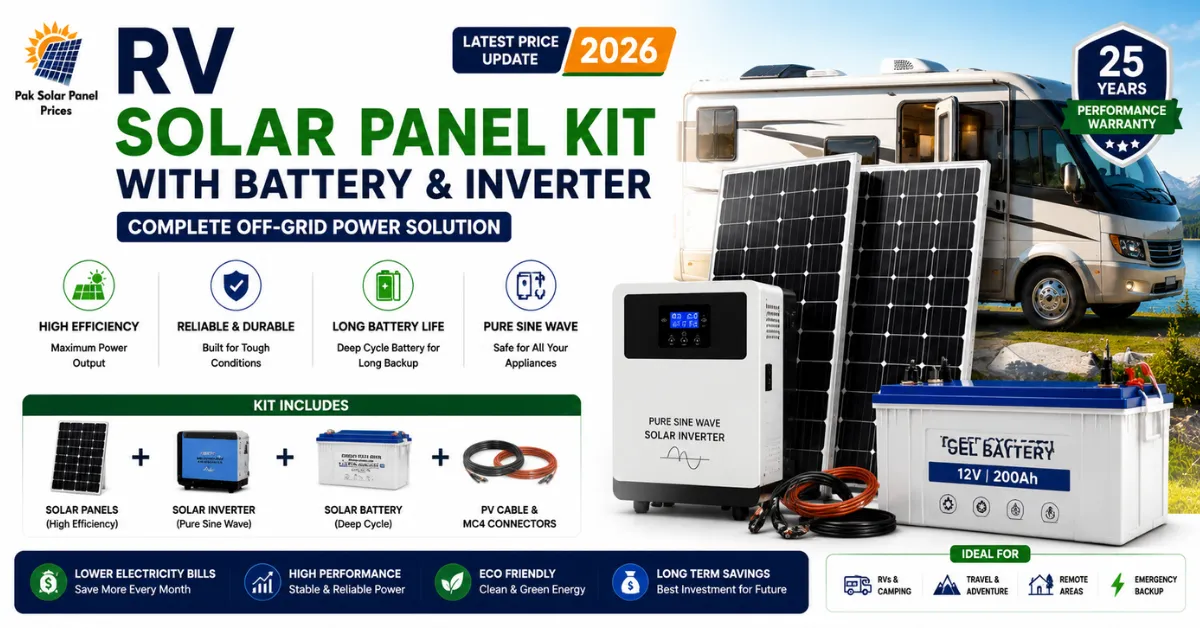
Best RV Solar Panel Kit with Battery and Inverter for Off-Grid Camping
Boondocking without a generator running all night sounds great in theory until your fridge dies at 2 AM because the battery bank was undersized. An RV Solar Panel Kit that bundles panels, battery, and inverter together removes most of that guesswork, but “complete kit” doesn’t mean “one-size-fits-all.” What actually matters is whether the components match how you camp, not just how many watts are printed on the box.
RV Solar Panel Kit with Battery and Inverter guide breaks down what’s really inside these kits, how to size one properly, and where most buyers go wrong including a few things most comparison articles skip entirely.
What’s Actually Inside a Complete RV Solar Panel Kit
A true all-in-one RV Solar Panel Kit has four core pieces working together, not just panels with a battery thrown in:
Skimping on any one of these four pieces creates a bottleneck a big battery paired with an undersized inverter, or a huge inverter paired with a battery that can’t sustain the load, both leave you with a system that looks impressive on paper but underperforms at the campsite.
Read More: Maryam Nawaz Solar Panel Scheme 2026 Registration & Latest Updates
Sizing Your System: The Math Nobody Wants to Do (But Should)
Before buying anything, calculate your actual daily energy use. List every appliance, its wattage, and how many hours a day you run it, then add it all up in watt-hours.
Example: A fridge running 8 hours a day at 60W, LED lighting for 4 hours at 30W total, a laptop charging for 3 hours at 65W, and phone charging adds up to roughly 800–1,000Wh per day for a modest setup closer to 2,000Wh if you’re running a CPAP machine, Starlink, or an induction cooktop regularly.
From there:
The single biggest sizing mistake isn’t undersizing the panels it’s underestimating surge loads. A rooftop AC unit alone can pull 2,500–3,000W just to start, even if it settles to 1,200W running. If AC is part of your plan, your inverter’s surge rating (not just continuous rating) needs to comfortably clear that spike.
Typical Wattage Tiers and What They Actually Support
| System Size | Best For | Realistic Daily Output |
|---|---|---|
| 200–400W | Weekend trips, lights/fridge/phone charging | 800–1,600Wh |
| 600–800W | Full-time RVers, laptops, Starlink, small appliances | 2,400–3,200Wh |
| 1,000–1,500W+ | Heavy users running microwaves, induction cooktops, occasional AC | 4,000–6,000Wh |
Most weekend campers overestimate what they need and end up overpaying for a system sized like a full-timer’s setup. Conversely, full-timers often underestimate and end up frustrated within the first month of continuous use.
Read More: Jinko Tiger Neo 585W Solar Panel Price in Pakistan 2026 | Latest Market Rates
LiFePO4 vs Lead-Acid: Why the Price Gap Is Worth It
| Factor | LiFePO4 | Lead-Acid/AGM |
|---|---|---|
| Usable capacity | ~90–100% of rated capacity | ~50% (deeper discharge shortens lifespan) |
| Cycle life | 3,000–4,000+ cycles | 300–500 cycles |
| Weight | Roughly half for the same usable capacity | Heavier — matters for RV payload limits |
| Charge speed | Fast, accepts high current | Slower, needs gentler charging |
| Upfront cost | Higher | Lower |
On paper, lead-acid looks cheaper. In practice, because you can only safely use about half its rated capacity, you often need double the lead-acid bank size to match one LiFePO4 battery’s real-world output which usually erases most of the initial savings within 2–3 years, especially once you factor in earlier replacement.
What Nobody Tells You About Running AC on Solar
Most RV Solar Panel Kit comparisons quietly avoid this question because the honest answer is “it’s complicated.” Running a rooftop air conditioner purely on solar and battery is possible, but only under specific conditions:
If AC is a non-negotiable part of your setup, budget for a system meaningfully larger than what generic 400–800W kits are built for, and treat any marketing claim of “runs your AC all night” with healthy skepticism unless the battery capacity backs it up on paper.
Budget Expectations by Tier
| Tier | Approx. Price Range (USD) | What You Get |
|---|---|---|
| Entry-level (200–400W) | $600 – $1,600 | Basic panels, small LiFePO4 battery, 1000–2000W inverter — good for weekend use |
| Mid-range (600–800W) | $1,600 – $3,500 | Larger battery bank, MPPT controller with monitoring, 2000–3000W inverter |
| High-capacity (1,000W+) | $4,000 – $10,000+ | Multi-kWh battery banks, 3000–5000W inverter/charger, expansion-ready wiring |
Prices swing based on brand reputation, battery chemistry grade, and whether the inverter includes a built-in charger for shore power/generator hookup a feature worth prioritizing since it lets you top up quickly on cloudy stretches without adding separate hardware.
Read More: Fronus Inverter Price in Pakistan 2026 – Latest Models, Specifications & Buying Guide
Installation Reality Check
Most kits are marketed as DIY-friendly, and for smaller systems (under 400W) that’s usually accurate basic wiring skills and a weekend are enough. Larger systems, especially anything involving multiple batteries wired in series/parallel or a 48V architecture, benefit from at least a professional wiring review even if you mount the panels yourself. A miswired battery bank isn’t just an inconvenience it’s a fire risk.
A few things that make installation smoother regardless of system size:
Common Mistakes RV Owners Make
Final Thoughts
The right RV Solar Panel Kit isn’t the one with the biggest wattage number on the box it’s the one where panels, battery, and inverter are sized around your actual usage pattern. Weekend campers running lights and a fridge can get by comfortably with a 400W setup, while full-time boondockers running laptops, Starlink, and occasional AC need to budget for a meaningfully larger battery bank and inverter than most “starter” kits provide. Doing the watt-hour math before buying not after is what separates a system that quietly works for years from one that leaves you guessing every evening whether the battery will last till morning.

 Join Channel