

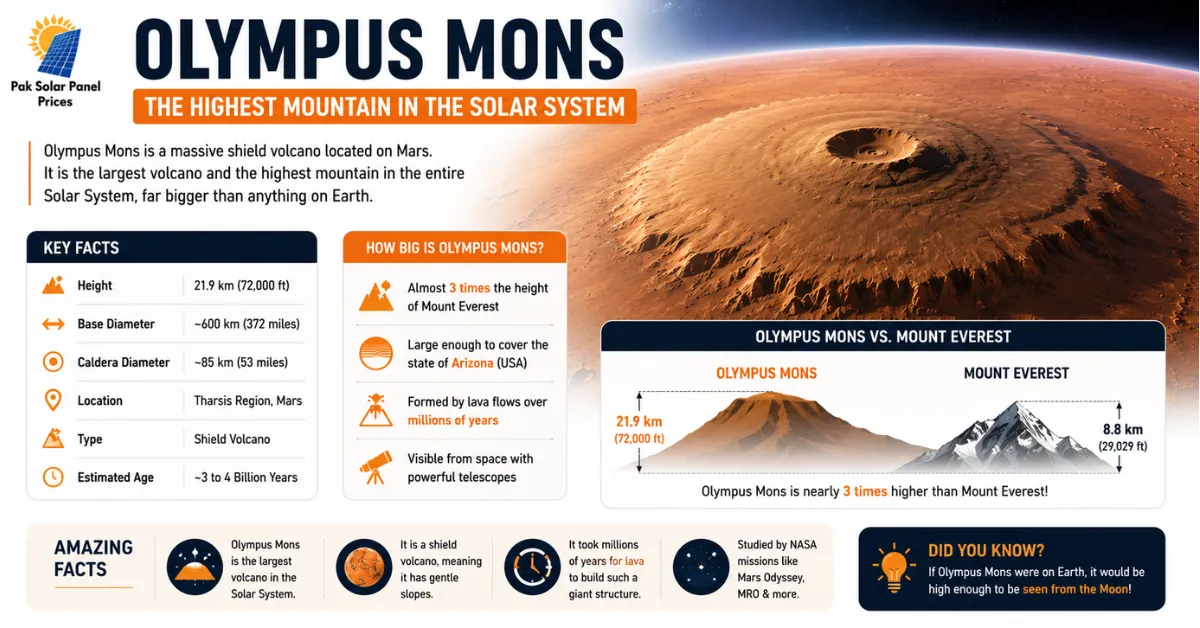
Which Planet Has the Highest Mountain in the Solar System? Olympus Mons Explained
Most people know Mount Everest as the tallest mountain on Earth 8,849 metres above sea level. It is the peak that has defined human ambition for over a century. Climbers have died trying to reach it. Nations have celebrated it. It holds a place in the popular imagination as the ultimate summit.
And yet, on a neighbouring planet barely 225 million kilometres away at its closest, there sits a mountain so vast it makes Everest look like a hill.
The planet is Mars. The mountain is Olympus Mons. And it is the highest mountain not just on Mars, but in the entire known solar system.
Quick Facts About Olympus Mons
| Feature | Measurement |
|---|---|
| Location | Mars (Tharsis Montes region, western hemisphere) |
| Type | Shield Volcano |
| Height above Martian surface | 21.9 – 25.7 km (13.6 – 16 miles) |
| Height vs Everest | ~2.5 to 3 times taller |
| Width / Diameter | ~601 km (374 miles) |
| Base Area | ~300,000 km² (size of Italy or Poland) |
| Summit Caldera | ~80 km wide, ~3.2 km deep |
| Cliff Height at Base | Up to 7–10 km |
| Last Known Eruption | ~25 million years ago |
| Average Slope | ~5% (extremely gentle) |
| Named by | NASA astronomers, 1971 |
Read More: 350 Watt Solar Panel Price in Pakistan 2026 | Latest Today Price List
What Is Olympus Mons?
Olympus Mons is a shield volcano on the planet Mars. Its name is Latin for “Mount Olympus” the legendary home of Zeus and the pantheon of Greek gods in ancient Greek mythology. The name is fitting. If any mountain in the solar system deserves to be named after the home of gods, it is this one.
As measured by the Mars Orbiter Laser Altimeter (MOLA), it stands 21.287 kilometres (69,840 feet) high approximately 2.5 times the elevation of Mount Everest above sea level.
Olympus Mons is not only Mars’s tallest volcano but also the highest point on the planet and the largest known volcano in the entire solar system. It sits in the Tharsis Montes region near the Martian equator a volcanic plateau that contains several enormous volcanoes, though none come close to the scale of Olympus Mons.
How Tall Is Olympus Mons Exactly?
The height of Olympus Mons depends on how you measure it, and this creates some interesting differences in the numbers you will see across different sources.
Measured from the Martian surface directly below it: Olympus Mons towers 16 miles (25 kilometres) above the surrounding plains.
Measured relative to Mars’s “areoid” (the Martian equivalent of sea level): Relative to the areoid an imaginary sphere having the average equatorial radius of Mars the mountain is about 21 km high.
In human terms, the simplest comparison: Standing at approximately 84,400 feet (25,750 metres) high, Olympus Mons is nearly three times taller than Mount Everest.
How Wide Is It?
Read More: 1 Ton Inverter AC Price in Pakistan 2026 | Today Updated Price List
The Summit: Six Craters in One
The Cliff at the Base Unique in the Solar System
One of the most extraordinary and puzzling features of Olympus Mons is the escarpment a sheer cliff that runs around much of its base. Nearly vertical cliffs rising more than 6 kilometres (3.7 miles) surround much of the volcano’s base. The volcano’s outer edge consists of a cliff up to 8 km tall a feature unique among the shield volcanoes of Mars, which may have been created by enormous flank landslides.
This basal cliff is one of the most debated features in Martian geology. Some scientists believe it was formed by catastrophic landslides as the volcano’s weight caused slope failures over billions of years. Others have proposed a more extraordinary theory that Olympus Mons originally formed as a volcanic island, and the escarpments represent ancient shorelines where lava flows met a prehistoric Martian ocean.
A recently published article in Earth and Planetary Science Letters suggests these escarpments formed when lava flowed into liquid water that an ancient Martian ocean had a water column at least 6 km thick when the volcanic island originally formed.
Why Is Olympus Mons So Enormous?
This is the question that fascinates planetary scientists most. Earth has volcanoes too Mauna Loa in Hawaii, Mount Etna in Italy, Krakatoa in Indonesia. Why does none of them come close to the scale of Olympus Mons? The answer involves three factors that work together on Mars in ways that simply do not occur on Earth.
1. Mars Has No Plate Tectonics
On Earth, the crust is divided into tectonic plates that move constantly roughly the speed your fingernails grow. When a volcanic hotspot exists beneath the crust, the moving plate carries the volcano away from the hotspot within a few million years. A new volcano then begins forming behind it. This is why Hawaii is a chain of islands rather than one giant mountain each island represents a different stage of the same hotspot, carried away by the Pacific Plate.
Mars’ crust remains stationary. As a result, lava flowing to the surface would continue to build up in a single spot, allowing the volcano to grow to an enormous height over billions of years. Olympus Mons sat over the same volcanic hotspot for billions of years, receiving lava eruption after eruption, with no plate movement to shift it away. The result is one colossal mountain instead of a chain of smaller ones.
2. Mars Has Weaker Gravity
Mars’ gravity is only about a third of what we experience on Earth. Weaker gravity means the planet’s crust can support a heavier volcanic structure without collapsing under its own weight. On Earth, a volcano of Olympus Mons’s mass would cause the crust beneath it to buckle and sink. On Mars, the thicker and more rigid lithosphere combined with lower gravity allowed the volcano to keep building upward without the base giving way.
3. Less Erosion on Mars
On Earth, mountains erode constantly. Rain, rivers, glaciers, wind, freeze-thaw cycles, and biological activity gradually wear mountains down over millions of years. Mars has almost no liquid water, no rain, no glaciers, and an extremely thin atmosphere that generates far weaker winds. The erosive forces that constantly reshape Earth’s mountains barely exist on Mars. Once lava solidified on the slopes of Olympus Mons, it largely stayed there.
Read More: Osaka Battery Price in Pakistan 2026 | Today Updated Price List for Car, UPS & Solar Batteries
What Kind of Volcano Is It?
Olympus Mons is what is called a shield volcano formed over hotspots of molten lava. Rather than erupt violently, its low-viscosity lava flows slowly but continuously over a longer period. This steady stream of lava hardens to form the volcano’s sides, which is why shield volcanoes have very gradual slopes.
The flanks of Olympus Mons are made up of innumerable lava flows and channels. Many of the flows have levees along their margins. Partially collapsed lava tubes are visible as chains of pit craters, and broad lava fans formed by lava emerging from intact, subsurface tubes are also common. The average slope of Olympus Mons is only about 5 degrees less steep than many hills you would walk up without thinking. This is what makes it a shield volcano rather than the dramatic conical stratovolcano shape most people picture when they imagine a mountain.
Would You Even Know You Were Climbing It?
Here is one of the most mind-bending aspects of Olympus Mons: despite being the tallest mountain in the solar system, standing on it would feel nothing like standing on a mountain.
Because of the size and shallow slopes of Olympus Mons, an observer standing on the Martian surface would be unable to view the entire profile of the volcano, even from a great distance. The curvature of the planet and the volcano itself would obscure such a synoptic view. Similarly, an observer near the summit would be unaware of standing on a very high mountain, as the slope of the volcano would extend far beyond the horizon, a mere 3 kilometres away.
In practical terms, if you were teleported to the midpoint of Olympus Mons’s slope, you would look around and see a gently sloping plain extending in every direction to the horizon. Nothing about the view would suggest you were standing on the solar system’s greatest peak. You would need instruments to know where you were.
Olympus Mons vs Everest The Numbers Side by Side
| Feature | Olympus Mons (Mars) | Mount Everest (Earth) |
|---|---|---|
| Height | 21.3 – 25.7 km | 8.85 km |
| Times taller | 2.5 to 3× Everest | — |
| Width / Diameter | 601 km | ~30 km base |
| Base Area | ~300,000 km² | ~700 km² |
| Summit Caldera | 80 km wide, 3.2 km deep | None (rocky peak) |
| Type | Shield Volcano | Fold Mountain |
| Average Slope | ~5 degrees | Up to 40–50 degrees |
| First confirmed | 1971 (Mariner 9) | 1856 (measured), 1953 (climbed) |
| Last eruption | ~25 million years ago | Never (not volcanic) |
| Atmosphere at summit | 72 Pascals (near vacuum) | 32,000 Pascals |
When Was Olympus Mons Discovered?
The story of how humans discovered Olympus Mons is as interesting as the mountain itself. Systematic observations of Mars began as early as the nineteenth century, but for a long time, astronomers could see only a bright patch where Olympus Mons is located today. On the earliest maps of Mars, this region was labeled Nix Olympica meaning “Snows of Olympus.” Scientists believed it might be an ice deposit, as telescope technology at the time did not allow them to resolve finer details.
The Italian astronomer Giovanni Schiaparelli, mapping Mars in the 1870s and 1880s, noticed the persistent bright spot and theorized it was the snow-covered summit of a mountain. He named it Nix Olympica the Snows of Olympus. The answer came only in 1971, when the Mariner 9 interplanetary probe reached the Red Planet. Images transmitted back to Earth revealed that the mysterious bright spot was in fact the tallest mountain in the solar system. To maintain continuity with earlier maps, scientists named it Olympus Mons.
Mariner 9 arrived during a planet-wide dust storm that obscured almost all of Mars’s surface. As the storm settled, the peaks of the four great Tharsis volcanoes emerged first the only features on the planet tall enough to protrude above the storm clouds. Olympus Mons was the most dramatic of them all.
Read More: Solar Power Inverter for Home in Pakistan 2026 | Best Prices & Buying Guide
Is Olympus Mons Still Active?
Olympus Mons is not erupting now, and has not erupted throughout the Space Age meaning in the time that humans have been sending rovers and probes to investigate Mars. It last erupted approximately 25 million years ago. In geological terms, that is relatively recent Earth’s continents moved substantially in that same timeframe.
But the bigger question is whether it is truly extinct or merely dormant. Crater counts from high-resolution images taken by the Mars Express orbiter indicate that lava flows on the northwestern flank of Olympus Mons range in age from 115 million years old to only 2 million years old. These ages are very recent in geological terms, suggesting that the mountain may still be volcanically active, though in a very quiescent and episodic fashion.
Scientists posit that Olympus Mons is still a fairly young volcano from a geologic standpoint, estimating it to be only a few million years old. There is a good chance that it is still active and could erupt at some point in the future. This means that Olympus Mons, which is already the size of France, could get even bigger as fresh lava flows to the surface and cools.
The Atmosphere at the Summit
Reaching the summit of Olympus Mons would bring you to the edge of the Martian atmosphere itself. Mars’ atmosphere is so thin that the volcano’s peak actually pokes out above it, meaning that if one were to hike to the summit of Olympus Mons, they would hike into space.
The typical atmospheric pressure at the top of Olympus Mons is 72 pascals about 12% of the average Martian surface pressure of 600 pascals. Both are exceedingly low by terrestrial standards; by comparison, the atmospheric pressure at the summit of Mount Everest is 32,000 pascals. At 72 pascals, the summit of Olympus Mons is, for all practical purposes, the vacuum of space. No current spacesuit technology could protect a human being in these conditions for long. Any future climber would need purpose-built equipment unlike anything that exists today.
Could Humans Ever Climb Olympus Mons?
Nearly vertical cliffs rising more than 6 kilometres, extreme radiation levels, and temperatures dropping to −90°C (−130°F) are just some of the challenges future explorers would face when attempting to climb Olympus Mons.
The cliff at the base alone presents a challenge that no mountaineer on Earth has ever faced. A 6–10 km vertical escarpment with no established route, in near-vacuum conditions, at temperatures that would freeze any exposed equipment instantly. Because of the challenges posed by the mountainous terrain, no probes have been able to land near Olympus Mons. NASA has been contemplating a human mission to Mars, but as of the early twenty-first century, the capability to accomplish the feat was still decades away.
Read More: Solar System on Installments in Pakistan 2026 – Easy Monthly Installment Plans
Other Giant Mountains in the Solar System
Olympus Mons is the tallest, but it is worth knowing how it compares to other notable peaks in the solar system:
| Mountain | Location | Height | Notes |
|---|---|---|---|
| Olympus Mons | Mars | ~21–26 km | Tallest known mountain in solar system |
| Rheasilvia | Asteroid Vesta | ~22 km | Comparable height, different type of body |
| Ascraeus Mons | Mars | ~18 km | Second tallest on Mars |
| Arsia Mons | Mars | ~16 km | Part of Tharsis group |
| Pavonis Mons | Mars | ~14 km | Part of Tharsis group |
| Maxwell Montes | Venus | ~11 km | Tallest on Venus |
| Mount Everest | Earth | 8.85 km | Tallest on Earth above sea level |
| Mauna Kea | Earth (Hawaii) | ~10 km (from ocean floor) | Earth’s tallest from base |
All four of the largest volcanoes in the Tharsis Montes region on Mars are taller than Mount Everest. Mars, despite being a smaller planet than Earth, is home to the most dramatic vertical relief in the solar system.
Frequently Asked Questions (FAQs)
Q: Which planet has the highest mountain in the solar system?
Mars. The mountain is Olympus Mons, a shield volcano standing approximately 21–26 km above the Martian surface roughly 2.5 to 3 times the height of Mount Everest.
Q: How tall is Olympus Mons compared to Everest?
Everest stands 8.85 km above sea level. Olympus Mons rises approximately 21.3 km above the Martian areoid and up to 25.7 km above the surrounding plains. It is between 2.5 and 3 times taller depending on the measurement method used.
Q: Is Olympus Mons the largest volcano in the solar system?
Yes. By both height and surface area (approximately 300,000 km²), Olympus Mons is the largest known volcano in the solar system. It is roughly the size of Italy or Poland in footprint alone.
Q: Why is Olympus Mons so much taller than any mountain on Earth?
Three main reasons: Mars has no plate tectonics (so the volcano stayed over one hotspot for billions of years), Mars has weaker gravity (so the crust could support a heavier structure), and Mars has far less erosion (no rain, rivers, or glaciers to wear it down).
Q: Is Olympus Mons still active?
It is classified as dormant rather than extinct. The last major eruption was approximately 25 million years ago, but some lava flows on its flanks are estimated to be only 2 million years old. Scientists believe it may still be capable of erupting in the far future.
Q: Can you see Olympus Mons from Earth with a telescope?
Not directly as a mountain Mars appears as a small reddish disk even through powerful telescopes. However, when Mars’s surface is covered by dust storms, the summit of Olympus Mons is sometimes the only feature visible above the storm clouds just as 19th-century astronomers observed it as a bright spot called Nix Olympica.
Q: When was Olympus Mons discovered?
Its mountainous nature was confirmed in 1971 when NASA’s Mariner 9 spacecraft sent back detailed images of Mars. However, astronomers had been observing a bright spot in the region called Nix Olympica since the 1800s.
Q: Could humans ever climb Olympus Mons?
Not with current technology. The challenges include near-vacuum atmosphere at the summit (72 pascals), temperatures down to −90°C, extreme radiation, and a basal cliff up to 10 km tall with no established route. Future missions to Mars may eventually make a human ascent possible, but it remains decades away at minimum.
A Mountain That Puts Everything in Perspective
Olympus Mons is more than a record in a list of planetary superlatives. It is a reminder of how varied and extreme the solar system truly is. The universe does not work on a human scale. The standards we use to measure greatness on Earth the height of Everest, the depth of the ocean, the breadth of continents are just one data point in a vastly larger range of possibilities.
On a planet with weaker gravity, a stationary crust, and billions of years of uninterrupted volcanic activity, nature built a mountain that makes our tallest peak look like a foothill. Olympus Mons has not been climbed. No human has stood at its base. No probe has landed on its slopes. And yet, we know its height to the metre, its caldera to the kilometre, and its geological history across billions of years all from spacecraft orbiting a planet tens of millions of kilometres away.






 Join Channel