

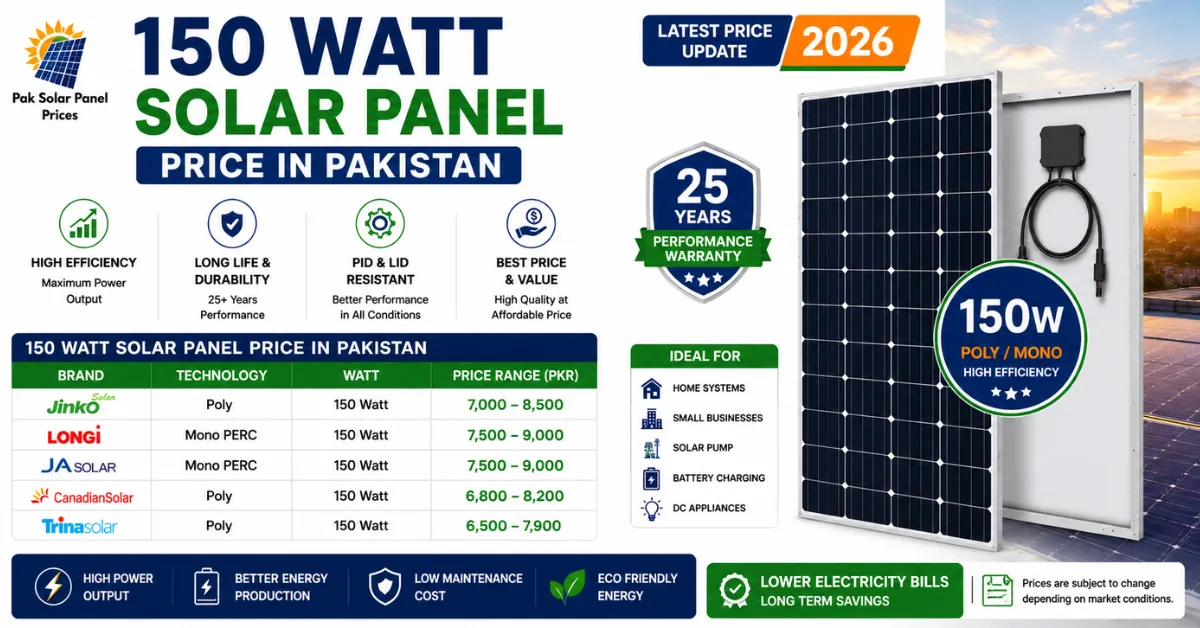
150 Watt Solar Panel Price in Pakistan 2026
Electricity bills keep climbing every few months, and load-shedding still hits many neighborhoods across Pakistan without warning. That combination has pushed a lot of households toward small, budget-friendly solar setups and the 150 watt solar panel has become one of the most searched options for anyone who just wants enough backup to keep a few lights and fans running.
150 Watt Solar Panel Price in Pakistan guide breaks down what a 150W panel actually costs in Pakistan right now, why prices differ from shop to shop, what it can realistically power, and how to avoid getting stuck with a low-quality panel.
Current Market Price
Based on rates from multiple solar retailers and marketplaces across the country, a standard 150 watt solar panel in Pakistan currently costs between PKR 7,000 and PKR 12,000. Premium monocrystalline or German-cell variants can go up to PKR 18,000–19,000, mainly because of better cell quality, higher efficiency, and longer warranty coverage.
Read More: AGS Battery Price in Pakistan 2026 – Latest Price List, Models & Buying Guide
Keep in mind this price is for the panel alone it doesn’t include the battery, charge controller, inverter, wiring, or installation labor. A complete small backup system built around a 150W panel usually costs several times more once those components are added.
City-Wise Price Comparison
Since transport costs, dealer competition, and import routes differ from city to city, the same 150W panel can cost slightly more or less depending on where you buy it:
| City | Typical Price Range (PKR) |
|---|---|
| Karachi | 7,000 – 9,500 |
| Lahore | 7,500 – 11,000 |
| Faisalabad | 8,000 – 10,000 |
| Islamabad/Rawalpindi | 8,000 – 11,500 |
| Multan | 7,800 – 10,500 |
Karachi generally offers the lowest rates because most solar equipment enters Pakistan through its port, cutting out extra transport markup. Smaller cities and towns often carry slightly higher prices simply because stock has to travel further and local dealers have less competition.
Brand-Wise Price Overview
Not every 150W panel is built the same, and brand plays a big role in both price and longevity. Here’s a general sense of where popular options fall:
| Brand/Type | Approx. Price (PKR) | Notes |
|---|---|---|
| Unbranded/local polycrystalline | 7,000 – 8,500 | Cheapest option, shorter lifespan, weaker warranty |
| Standard A-grade monocrystalline | 8,500 – 11,000 | Good balance of price and performance |
| Branded Tier-1 (Longi, Jinko, Canadian, JA Solar — smaller wattage lines) | 10,000 – 14,000 | Better efficiency, stronger warranty support |
| German-cell / premium monocrystalline | 15,000 – 19,000 | Highest efficiency and durability, priced accordingly |
Most well-known Tier-1 manufacturers don’t heavily focus on very small panels like 150W their main lineups are built around 500W+ panels for larger systems. A lot of the 150W market in Pakistan is actually filled by local assemblers and smaller solar brands, which is exactly why quality varies so much at this wattage.
Read More: Solis Inverter Price in Pakistan 2026 – Latest Models, Features & Complete Buying Guide
Why Prices Vary So Much
A few factors decide where a specific panel falls in that price range:
If you spot a 150W panel priced noticeably below PKR 7,000, treat it with suspicion it’s very likely refurbished, B-grade, or mislabeled to appear more powerful than it actually is.
What Can a 150W Panel Actually Run?
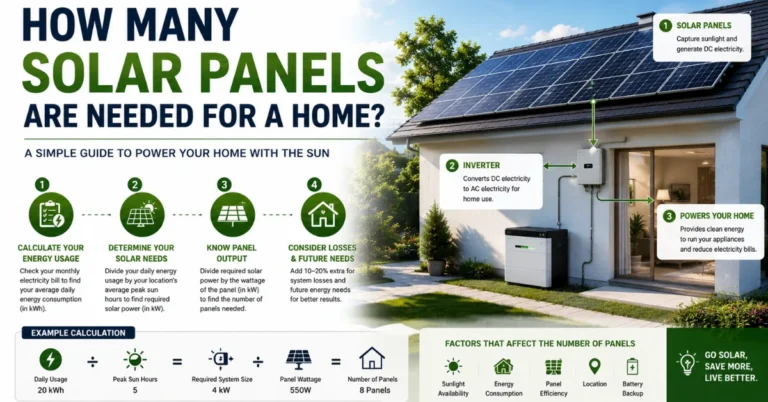
This is where a lot of buyers get the wrong idea. A 150-watt rating is the panel’s maximum output under ideal sunlight it doesn’t produce that continuously all day. Pakistan generally gets around 5 to 6 peak sun hours daily, so realistic output lands somewhere around 750–900 watt-hours per day.
In practical terms, that’s enough to comfortably run:
It is not enough to run air conditioners, refrigerators, or motors those need a much larger system, typically starting from 500W and up. Pairing the panel with a 12V 80Ah–100Ah battery and an MPPT or PWM charge controller gives the most consistent backup for evenings and outages.
Is It Worth Buying?
For someone who just wants basic lighting and fan backup during outages, a 150W panel is one of the cheapest ways to get there. Over a year, a single panel used consistently can save a noticeable amount on electricity bills often estimated in the range of PKR 10,000–15,000 annually depending on usage and a well-maintained panel typically lasts 20 to 25 years with almost no upkeep beyond occasional cleaning.
That said, if your budget stretches a bit further, jumping to a 200W or 300W panel often makes more financial sense per watt, since larger panels typically come with a slightly lower per-watt cost and give you more room to expand later without buying an entirely new system.
How to Avoid Fake or Low-Quality Panels
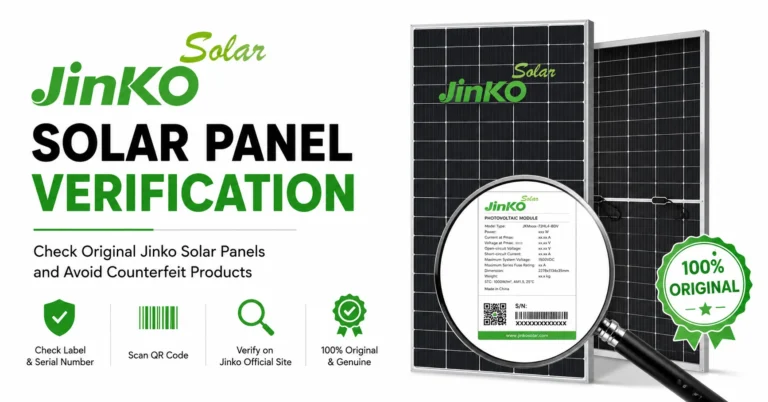
Since 150W panels are the entry point for a lot of first-time solar buyers, they’re also a common target for counterfeit or mislabeled products. Before buying:
Final Thoughts
A 150 watt solar panel in Pakistan currently sits in the PKR 7,000–12,000 range for standard options, with premium versions going higher. It’s a solid, low-cost entry point for basic backup power lights, fans, and small electronics but not a full home solution. Buyers looking for long-term value and scalability might find that stepping up to a 200W or higher panel pays off better in the long run, especially with electricity costs unlikely to come down anytime soon.

 Join Channel