

Solar Panel Demand in the Philippines 2026 – Latest Market Trends & Growth
Something remarkable is happening on the rooftops of the Philippines. In cities from Manila to Cebu, on houses in Davao and on the islands of the Visayas, solar panels are appearing faster than anyone predicted. Not because of government mandates alone. Not because of environmental policy. But because Filipino households and businesses have reached a breaking point with electricity bills and solar has become the most practical way out.
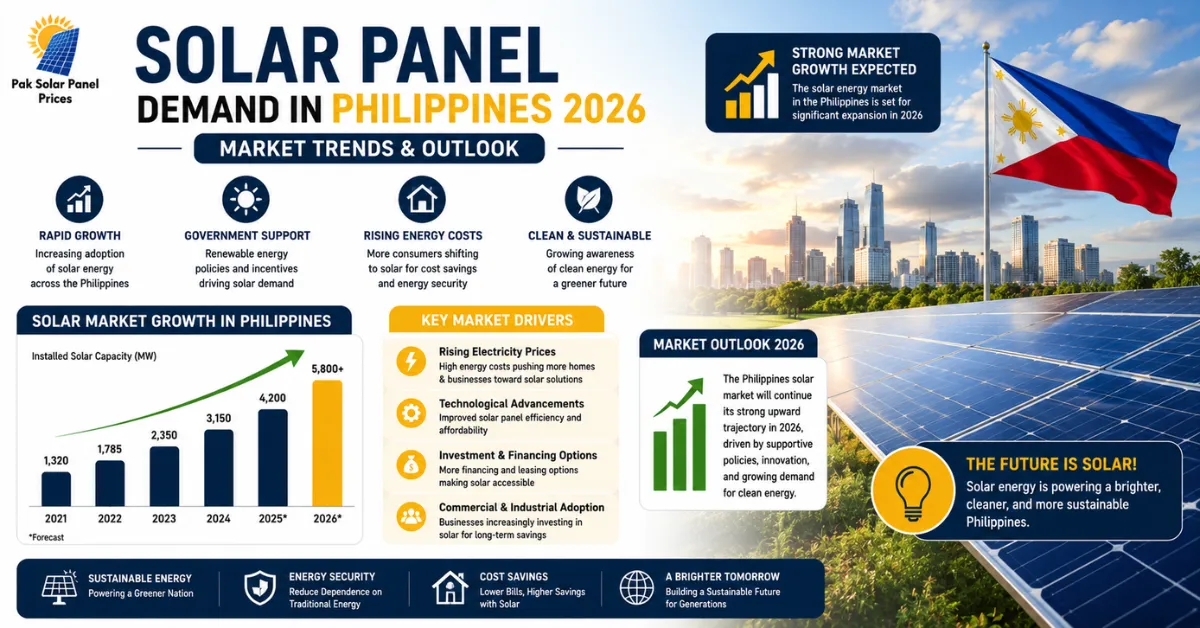
The Philippines is now the world’s fastest-growing rooftop solar market and China’s second-largest export destination for solar panels in 2026, surpassing even Pakistan. That single fact tells you everything about the speed and scale of what is happening.
This guide covers the full picture: why demand is surging, the market size and forecasts, who is buying, what policies are driving it, what challenges remain, and where the market is headed.
Philippines Solar Market at a Glance – 2026
| Indicator | Figure |
|---|---|
| Installed Solar Capacity (2025) | 4.25 GW |
| Projected Installed Capacity (2026) | 5.43 GW |
| Projected Capacity by 2031 | 18.49 GW |
| CAGR (2026–2031) | 27.78% |
| Market Size (2025) | USD 2.06 billion |
| Market Size Forecast (2033) | USD 4.54 billion |
| Rooftop Solar Capacity (2025) | ~1,846 MW (and growing fast) |
| Solar Panel Imports (2025) | USD 483 million |
| Solar Panel Imports (Jan–Apr 2026) | 4,000+ MW from China alone |
| Payback Period (Rooftop, 2026) | 3.1 years |
| China Ranking (Solar Export Market) | 2nd largest globally (2026) |
Read More: 15kW Solar System Price in Pakistan Latest Update Price
The Philippines Is Now the World’s Hottest Solar Market
In May 2026, the Philippines made headlines in the global energy industry for a reason no one expected: it overtook Pakistan to become China’s second-largest solar panel export market, trailing only the Netherlands and the Netherlands is widely understood to be a transshipment hub, not an end consumer.
The Philippines has surpassed Pakistan as a key destination for Chinese solar exports, with solar panel shipments to Manila exceeding 4,000 megawatts (MW) in the first four months of 2026 alone.
From October 2025 to July 2026, exports of solar cells to the Philippines reached USD 292 million (about PHP 18 billion), up sharply from almost zero in previous periods.
The rooftop solar rush resulted in USD 407 million in panel imports in the three months through May 2026 a 145% increase from a year earlier.
These are not the numbers of a market gradually adopting solar. These are the numbers of a country in the grip of an energy crisis turning to solar as the most immediate available solution.
Read More: Best RV Solar Panel Kits with Battery and Inverter – How to Choose the Right One
Why Is Solar Demand Exploding in the Philippines?
The Philippines solar surge is not a single story it is the result of several forces converging at once in 2026.
1. The Highest Electricity Prices in Southeast Asia
2. The Economics of Rooftop Solar Have Never Been Better
3. Solar Panel Prices Have Fallen Dramatically
4. Net Metering Reform Makes Solar More Attractive
5. Government Auctions Are Driving Utility-Scale Investment
6. Data Centers and BPO Companies Demanding Clean Energy
Read More: Best Solar Inverter in Pakistan 2026 – Top Brands, Prices and Buying Guide
The Rooftop Solar Revolution
While utility-scale solar grabbed early attention, the most exciting development in the Philippines in 2026 is what is happening on rooftops. Rooftop solar has almost doubled in the last 12 months. The Institute for Climate and Sustainable Cities measured rooftop solar capacity at 712 MW using satellite images up to January 2025. Generation data from IEMOP (the electricity market operator) suggests a further 600 MW came online in the 12 months to August 2026.
In 2026, the Philippines’ net imports of solar panel capacity (5,068 MW) were more than five times the grid-connected utility-scale solar installed (800 MW) a clear sign that most of the panels entering the country are going onto rooftops, not large power plants. In two years, distributed solar capacity could nearly triple to 3,500 MW, matching the current size of the Philippines’ entire utility-scale solar fleet.
Social media has played an unexpectedly powerful role. Stories of families whose refrigerators kept running during neighbourhood blackouts spread rapidly, creating peer pressure and excitement that accelerated adoption faster than any marketing campaign could.
Who Is Buying Solar in the Philippines?
Residential Buyers Fastest Growing Segment
Residential rooftops are forecast to outpace all other segments at a 31.60% CAGR through 2031. The combination of high electricity bills, falling panel costs, a 3.1-year payback, and easy financing has made solar a mainstream purchase decision for Filipino homeowners.
The typical residential system ranges from 6 kW to 20 kW, with many buyers adding battery storage to handle evening demand and the frequent power outages that affect many areas.
Commercial and Industrial (C&I) Driven by Economics and ESG
Commercial and industrial buyers occupy the middle tier of solar adoption, motivated by two forces: tariff hedging (locking in energy costs before electricity prices rise further) and ESG commitments (corporate sustainability targets and investor pressure to reduce carbon emissions).
The expanded 1 MW net metering cap has made commercial rooftop solar dramatically more attractive for offices, warehouses, hotels, malls, and manufacturing facilities. Many are also pairing panels with battery storage to qualify for 24/7 clean power agreements with clients.
Utility-Scale Developers The Volume Leader
Utility-scale assets captured 72.15% of 2025 capacity, reflecting auction-driven growth and large corporate PPAs. The Philippines has attracted significant foreign investment in large-scale solar, with companies including ACEN, Aboitiz Power, Citicore, and international developers all competing for auction allocations.
The largest single project underway is Terra Solar a 3.5 GW solar plant paired with 4.5 GWh of battery storage, which will be one of the largest solar-plus-storage projects in the world when completed.
Off-Grid Communities A Critical Underserved Market
Nearly 4.5 million households in the Philippines do not have access to electricity. As an archipelago of over 7,000 islands, connecting remote communities through conventional grid infrastructure is expensive and slow.
Off-grid solar small standalone systems for households and community microgrids is playing a growing role in universal electrification. Though small in absolute installed capacity terms, off-grid solar is critical for the communities it serves: replacing expensive and polluting diesel generators on remote islands with clean, local solar power.
Read More: SAJ Solar Inverter Price in Pakistan 2026 – Latest Models and Today Price List
Market Size and Growth Forecast
Installed Capacity Trajectory
| Year | Installed Capacity | Source |
|---|---|---|
| 2025 | 4.25 GW | Mordor Intelligence |
| 2026 | 5.43 GW | Mordor Intelligence |
| 2031 | 18.49 GW | Mordor Intelligence |
Growth at 27.78% CAGR between 2026 and 2031 would make the Philippines one of the fastest-growing solar markets in Asia and among the fastest in the world.
Market Value
The Philippines Solar Energy Market was valued at USD 2.06 billion in 2025 and is projected to reach USD 4.54 billion by 2033, representing a CAGR of 9.17% on a revenue basis.
Energy Generation Trajectory
The Philippines solar energy market reached around 2.63 TWh in 2025 and is projected to grow at 17.90% CAGR between 2026 and 2035, reaching nearly 13.65 TWh by 2035.
Investment Expected
The solar energy market in the Philippines is expected to attract an investment of USD 2.8 billion by 2030 as the country scales toward its renewable energy targets.
Government Policy and Regulatory Framework
The policy environment for solar in the Philippines is one of the most supportive in Southeast Asia and has been getting stronger.
National Renewable Energy Program (NREP) 2020–2040
The overarching policy framework sets ambitious targets:
Solar is the primary technology expected to deliver these targets.
Green Energy Auction Program (GEAP)
The GEAP provides competitive, government-backed off-take agreements for large renewable energy projects. Four rounds have been completed, with the fourth round awarding 10.2 GW. From GEA-4 onwards, battery integration is mandatory a significant policy signal toward storage-paired renewables.
Net Metering Reform (2024)
The expansion of the net metering ceiling from 100 kW to 1 MW opened commercial and industrial rooftops to grid-connected solar at scale. The expedited approval process (10 days from distribution utility, 3 days for electrical permits) introduced in early 2026 further reduced friction for residential and commercial installations.
Renewable Portfolio Standards (RPS)
The Renewable Portfolio Standards require electricity suppliers to source a minimum percentage of their supply from renewable energy. This creates a mandatory market for renewable energy certificates and supports developer revenues from green energy sales.
Government Solar Loan Program
The government provides loans for solar of up to PHP 500,000 at 5% interest well below market rates. However, the current program excludes private-sector workers, limiting its reach to government employees. Expanding this program to private-sector workers is a key advocacy priority for the solar industry.
Key Players in the Philippines Solar Market
Local Companies
Citicore Power Inc. One of the most active utility-scale solar developers in the Philippines. Citicore has built multiple large-scale plants across Luzon and has significant pipeline projects in auction allocation.
Aboitiz Power Corp. A major Philippine conglomerate with growing renewable energy investments. Aboitiz has been expanding its solar portfolio through both own-development and acquisitions.
Solar Philippines A pioneering local solar developer and installer that has been active in both rooftop and utility-scale projects since the early days of the Philippines solar market.
Solaric Corp. One of the largest rooftop solar installers in the Philippines, focused on residential and commercial installations.
Philergy German Solar A Manila-based installer known for quality systems, the company has seen demand surge dramatically in 2026, with over 3,000 inquiries per day during peak demand periods.
Solenergy Systems Inc. A solar installation company serving residential, commercial, and industrial segments.
International Companies Active in the Philippines
Terra Solar Developer of the 3.5 GW solar + 4.5 GWh storage project, the largest renewable energy project in Philippine history.
ACEN Part of the Ayala Group, with significant floating solar investments including projects on Laguna Lake.
Trina Solar Tier-1 Chinese panel manufacturer with growing market share in the Philippines.
Blueleaf Energy Active in floating solar development on irrigation reservoirs.
Floating Solar A New Frontier
One of the most innovative developments in Philippines solar is the rapid emergence of floating solar panels mounted on water bodies rather than land. Reservoir-based arrays avoid land-acquisition delays, deliver up to 10% higher yields (because water cooling reduces panel temperature), and have 2.6 GW of announced capacity led by ACEN and Blueleaf Energy.
In 2024, a study found that Mars’s equatorial volcanoes [Note: this is a different topic; see Ember’s data below] Ember found that floating solar on Laguna Lake and agricultural irrigation reservoirs is emerging as the most practical land-neutral alternative for the Philippines’ densely populated lowlands where land costs are prohibitive.
The Philippines’ National Irrigation Administration has signed a Memorandum of Understanding for floating solar deployment on irrigation reservoirs potentially unlocking hundreds of megawatts of new capacity without the land acquisition challenges that slow ground-mounted projects.
Challenges Facing the Philippines Solar Market
Despite the impressive growth, several real obstacles continue to constrain the market’s full potential.
High Electricity Prices Are Both Driver and Victim
The same high electricity prices that make solar attractive also reflect an economy under energy stress. While solar investment is growing, the immediate crisis particularly driven by a weakening peso and fossil fuel import dependence is creating economic hardship that slows purchasing power for those who need it most.
Fragmented Grid Infrastructure
The Philippines’ archipelagic geography creates fundamental grid challenges. Only 6 of 16 priority transmission projects were completed by 2023, delaying the PHP 52 billion Mindanao-Visayas backbone interconnection by three years.
These bottlenecks restrict solar additions south of Luzon, compelling developers to cluster where interconnection is available and leaving significant solar irradiance in Visayas and Mindanao unexploited.
High Financing Costs
The weighted average cost of capital for Philippine power projects stands at approximately 9%, compared to sub-8% in Malaysia and Thailand, and approximately 6–7% in Vietnam. Higher financing costs raise developer hurdle rates and limit solar-plus-storage ventures, especially for smaller projects.
High Upfront Costs for Residential Buyers
Despite a 3.1-year payback, the upfront cost of a rooftop system is still above the average annual household income in the Philippines. The government loan program is limited to government employees. Private-sector workers the majority of the workforce must rely on commercial bank financing at higher rates, micro-lending platforms, or installment programs offered by installers.
Installations are lagging behind demand due to component hoarding, volatile equipment costs, and inadequate quality checks issues the industry is working to address but that are creating bottlenecks during the current surge.
Interconnection Delays for Utility-Scale Projects
Even when a large solar project secures an auction allocation, connecting it to the grid can take years. Transmission operator NGCP carries an approved 15.04% rate of return, inflating developer costs. Interconnection delays are concentrated south of Luzon, leaving abundant solar resources in Mindanao and the Visayas underutilized.
Philippines vs Southeast Asian Solar Neighbors
| Country | WACC | Electricity Subsidies | Residential Solar Growth | Solar Payback |
|---|---|---|---|---|
| Philippines | ~9% | Almost none | Very high (fastest in SEA) | 3.1 years |
| Vietnam | 6–7% | Moderate | High | 4–5 years |
| Malaysia | ~6% | Significant | Moderate | 5–7 years |
| Thailand | ~6% | Moderate | Growing | 5–6 years |
| Indonesia | ~8% | Significant | Growing | 5–7 years |
The Philippines stands out in this comparison for a painful reason: it is the only major Southeast Asian economy with almost no electricity subsidies. This makes its residential prices the highest in the region and its demand for rooftop solar the most urgent.
The Road to 35% Renewables by 2030
The Philippines’ National Renewable Energy Program target of 35% renewable energy in the power mix by 2030 is ambitious. As of 2021, renewables accounted for 22% of overall electricity generation. Closing the gap from 22% to 35% in under a decade requires sustained installation at the pace currently seen and probably faster.
Solar is the primary technology expected to drive this. Wind, geothermal, and hydro contribute, but solar’s falling costs, faster build times, and distributed nature make it the most scalable option across the archipelago.
The Green Energy Auction Program’s development pipeline of 36+ GW if executed would comfortably achieve and surpass the 35% target. The challenge, as always, is execution: securing transmission connections, financing, and permitting at the pace required.
The Long View: What Philippines Solar Looks Like by 2031
By 2031, the Philippines Solar Energy Market is forecast to reach 18.49 GW of installed capacity more than four times the 2026 level.
Residential rooftops will be the fastest-growing segment, outpacing even commercial and utility-scale growth, as continued bill increases, shorter payback periods, and easier financing push solar into mainstream Filipino consumer culture.
Local manufacturing is expected to begin scaling, with a burgeoning domestic module production industry anticipated to produce 3–5 GW of modules annually by 2030 reducing import dependence and improving supply chain resilience.
The integration of battery storage mandatory in new utility-scale auctions, increasingly common in commercial and residential installations will transform solar from an intermittent daytime resource into a round-the-clock energy solution.
If the transmission infrastructure catches up with the development pipeline, Visayas and Mindanao will finally unlock their considerable solar irradiance potential, distributing growth beyond Luzon’s current dominance of 78.40% of national technical capacity.
Frequently Asked Questions (FAQs)
Q: Why is solar panel demand so high in the Philippines in 2026?
The Philippines has the highest residential electricity prices in Southeast Asia, almost no power subsidies, and a weakening peso that raises the cost of imported coal and gas.
Q: Is the Philippines really China’s second biggest solar market?
Yes, as confirmed by global energy think tank Ember and reported by Philstar in 2026. China exported over 4,000 MW of solar panels to the Philippines in just the first four months of 2026, making it China’s second-largest solar export destination after the Netherlands.
Q: How fast is the Philippines solar market growing?
The market is projected to grow from 4.25 GW in 2025 to 18.49 GW by 2031 a CAGR of 27.78%. Residential rooftop solar is the fastest-growing segment at a projected 31.60% CAGR.
Q: How long does it take to get solar installed in the Philippines?
Installation itself takes 1–3 days for a residential system. Net metering approval now takes 10 days (down from months previously) and electrical permits are issued within 3 working days — significant improvements introduced in early 2026.
Q: What is the payback period for rooftop solar in the Philippines?
As of 2026, the average payback period for rooftop solar in the Philippines is 3.1 years down from 4 years previously. After payback, the system provides essentially free electricity for 20+ more years.
Q: Who are the major solar companies in the Philippines?
Major local companies include Solar Philippines, Solaric Corp., Philergy German Solar, Citicore Power, and Aboitiz Power. International players include Terra Solar, ACEN, Trina Solar, and Blueleaf Energy.
Q: What is the Philippines’ renewable energy target?
Under the National Renewable Energy Program 2020–2040, the Philippines aims for renewables to account for 35% of the power mix by 2030 and 50% by 2040, with total renewable capacity reaching 102,231 MW by 2040.
A Market Defined by Urgency
The Philippines solar story in 2026 is not a story of gradual policy-driven transition. It is a story of urgency of a country with among the highest electricity prices in Asia, an archipelagic geography that limits conventional energy infrastructure, and over 116 million people increasingly unable or unwilling to keep paying fossil fuel bills.
The result is the fastest residential solar adoption in Southeast Asia, a booming rooftop market that has nearly doubled in twelve months, and a country that has become the second-largest market for solar panels in the world by import volume.
The challenges grid bottlenecks, high financing costs, inadequate transmission south of Luzon are real and material. But they are not stopping the market. They are slowing it from being even faster.

 Join Channel