

How to Calculate Solar Panel Requirements in Pakistan? Complete Guide
Calculating the right number of solar panels is one of the most important steps before installing a solar system. Choosing too few panels may leave a home dependent on grid electricity, while installing far more capacity than required can unnecessarily increase the project cost.
Solar capacity is calculated keeping in mind the amount of electricity being consumed and not just the size of the house. There are several factors which help in calculating the Solar Panel Requirements numbers, which include monthly units, daily consumption, number of hours of sunshine, watts produced per panel, losses in the system, inverters, batteries, and roof space.
Start With Your Electricity Bills
The simplest method to assess solar needs would be to look into the past few electricity bills of the family. This will give you an idea of how many units of electricity the home consumes per month.
It is always preferable to look at a period of at least six months to twelve months of electricity bills rather than just one month. Electricity consumption might spike in summer due to air conditioners and coolers, and drop significantly in winter.
Read More: 100 Watt Solar Panel Price in Pakistan 2026 – Latest Prices and Features
What Are Peak Sun Hours?
Peak sun hours are not the same as the total number of hours of daylight. They refer to the equivalent number of hours when the solar radiations are on average equal to the standard used in calculating the solar radiation. Solar energy is abundant in Pakistan, but it depends on the location and season. An approximate estimate of peak sun hours can be assumed initially for calculations followed by fine-tuning based on local data.
Solar Panel Requirements by System Size
The following examples show how panel wattage changes the number of modules required.
| Solar System | 450W Panels | 550W Panels | 580W Panels | 600W Panels |
|---|---|---|---|---|
| 3kW | 7 | 6 | 6 | 5 |
| 5kW | 12 | 10 | 9 | 9 |
| 6kW | 14 | 11 | 11 | 10 |
| 8kW | 18 | 15 | 14 | 14 |
| 10kW | 23 | 19 | 18 | 17 |
Example: Calculating Panels for a 500-Unit Home
Suppose a household consumes 500 units per month.
Average daily consumption:
- 500 ÷ 30 = 16.67 kWh/day
If an estimated five peak-sun hours and 80% overall system efficiency are used:
- 16.67 ÷ 5 ÷ 0.80 ≈ 4.17kW
A system around 4.5kW to 5kW could therefore be considered for further evaluation. Using 550W panels, a 5kW-class array would require approximately:
- 10 × 550W = 5.5kW
Example: Calculating Panels for 1,000 Units
For a household consuming 1,000 units per month:
- 1,000 ÷ 30 = 33.33 kWh/day
Using five peak-sun hours and 80% system efficiency:
- 33.33 ÷ 5 ÷ 0.80 ≈ 8.33kW
Read More: Q CELLS Solar Panel Price in Pakistan 2026
Calculate Your Daytime Load
Make a list of appliances that normally operate while the sun is available.
| Appliance | Approx. Power | Daily Usage |
|---|---|---|
| Refrigerator | 150–250W average | 24 hours cycling |
| Ceiling Fans | 60–100W each | Several hours |
| LED Lights | 8–20W each | Several hours |
| Water Pump | 500–1,500W+ | Limited hours |
| Air Conditioner | Varies by model | Several hours |
| Television | 80–150W | Several hours |
Convert Monthly Consumption Into Daily Usage
Once you have determined the monthly average consumption, it is easy to determine the approximate daily consumption for your electricity use. For example, suppose the total electricity consumption for the month is about 900 units. It implies that the total daily consumption is around 30kWh.
How Air Conditioners Affect Solar Panel Requirements
Air conditioners can be the reason why one needs a bigger solar system in a residential building. Three air conditioners working several hours per day will lead to higher energy consumption compared to the house with fans and regular appliances. Moreover, inverter air conditioners can consume different amount of electricity depending on the temperature and loading of the compressor. It means that using the maximum power of ACs is not always the right approach while considering the energy consumption of a house. Therefore, it is important to consider ACs’ operation hours and estimated energy consumption.
Calculate Solar Panel Requirements for Water Pumps
Water pumps are also typical components of the houses in Pakistan. The water pump will consume relatively much power but operate for a certain amount of hours per day. It means that its influence on solar system depends on both its power and operating hours.
The electricity needed to run the pump will be provided by solar panels during the daytime hours. In case if the pump is used in the nighttime, the electricity can come from battery or the mains.
Read More: Polycrystalline Solar Panel Price in Pakistan 2026
How Battery Storage Changes the Calculation
The battery requirement should be calculated separately from the solar system requirement. The battery serves as the energy storage and it depends on whether the household wants some backup time after the sunset. It also depends on what devices they want to use after the sunset.
For example, running the light bulbs, fans, refrigerator and internet equipment does not consume much energy, while running a few air conditioners consumes significantly more of it.
Check Available Roof Space
The required number of panels must physically fit on the property. Modern 550W–600W panels can produce substantial power per module, but they are also relatively large. Roof planning should include space for:
- Panel rows
- Maintenance access
- Walkways
- Water tanks
- Roof structures
- Shading clearance
- Mounting equipment
Solar Panel Requirements for Common Home Sizes
House size can provide a rough context, but electricity consumption remains the more important factor.
| Home Type | Possible Solar Range |
|---|---|
| Small home with basic loads | 2kW–4kW |
| Medium family home | 4kW–7kW |
| Large home | 7kW–10kW+ |
| Home with multiple ACs | 8kW–15kW+ |
Common Mistakes When Calculating Solar Panel Requirements
The first one is using the maximum panel wattage as the panel output per day. System inefficiencies are another oversight. Some customers make calculations using monthly electricity units without taking into account when these units are consumed. The third pitfall may be roof shade, battery needs, and inverter constraints. The calculation must take into account energy usage, conditions of generation, equipment specifications, and future needs.
Read More: Bifacial Solar Panel Price in Pakistan 2026
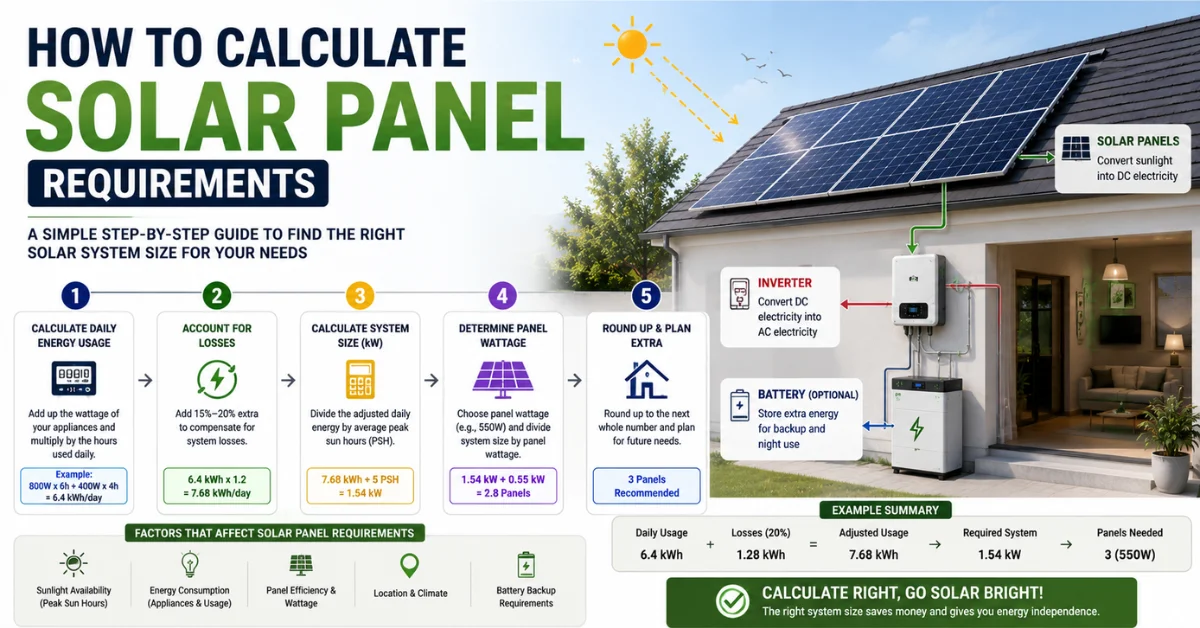
A Simple Solar Panel Calculation Method
The following tips will help homeowners to make the simplest solar panel calculation:
- Step 1: Check electricity units from the latest several bills.
- Step 2: Determine average daily electricity usage.
- Step 3: Find out the peak sun hours for your area.
- Step 4: Consider system losses.
- Step 5: Make the estimation of the solar capacity.
- Step 6: Divide the required capacity by the selected panel wattage.
- Step 7: Check the inverter’s PV voltage and current limits.
- Step 8: Confirm that the panels fit on the available roof.
- Step 9: Add battery capacity if nighttime or backup power is required.
Conclusion
The calculation of solar panel requirements is not as simple as just dividing the monthly electricity units consumed in the house by panel wattage. The calculation of solar energy requirements involves first determining the daily energy consumption of the house. This is followed by consideration of peak sunlight hours and system losses to arrive at the total solar requirement. This is then followed by determining the panel wattage to use and hence the number of panels. For instance, a 5kW class system might need about ten panels using 550W panels.
However, the calculations should not stop there. Other considerations include the inverter requirements, battery requirements, available roof space, shading, panel orientation, and future electricity consumption.



 Join Channel